A weird one on a system of ‘weird ones’. Boogie Loops is a music tracker (a type of synthesiser) in the vein of the music-making components of creative software games like Mario Paint or WarioWare DIY. Crank usage is the most daring I’ve seen yet: none at all. This is the first Playdate release in Season One that doesn’t feature a unique function that only the crank can provide. In fact, it’s probably the first game to seriously chafe at the system’s limitations. Then again, calling it a game at all may be a bit strong. Like Whitewater Wipeoutand Casual Birder, it did get me thinking more about what the Playdate’s ethos and purpose in the modern handheld world is than the software itself.
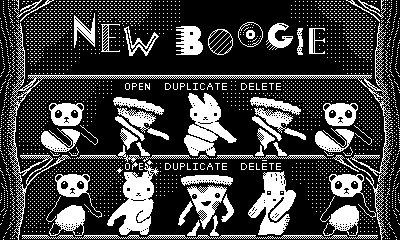
Boot it up. No title screen. Half the screen will be occupied by cute creatures dancing in time to a sequence of notation on the bottom half. A pre-made beat and melody far beyond anything I have the skill or patience to approximate can be played and altered right away. There isn’t any in-game documentation as to how to engage with it. While you’ll certainly wring more out of it if you have a rudimentary understanding of music theory or how to use a tracker, you’ll still have to find out through trial-and-error what odd sound sample each piece of iconography represents.
Part of the Playdate’s appeal, it seems, is that it wants to instill a little bit of mindfulness in your gaming diet. Games may not be cheap these days, but they are plentiful. At the time of writing, it is 2024. Despite being considered a ‘slow’ year, there is still more coming out than any one person could reasonably keep up with. I really feel for indie developers (and, increasingly, even major ones): you toil on a project for years and if you’re lucky you’ll get 15 minutes of fame and recoup costs before it gets lost in the sauce of constant, unrelenting big name releases and interesting smaller projects. Because the Playdate serves you two games weekly (with more available individually at a price), it encourages you to stick with them until next week. I wouldn’t give Whitewater Wipeout a second look if it was free on Steam, but the attention afforded it by being one of my two weekly games meant I stuck with it longer.
Like Whitewater Wipeout, I would say that having this be the fourth ‘game’ out of the gate in your system’s first season of 24 games is a little early, but I don’t want to levy that too hard against Boogie Loops itself. If it’s your first time seeing a music tracker, then its cute and lively presentation, with absolutely zero direction as to how to use it or what things do, encourages experimentation. Unfortunately, unless you have tremendous patience, then its limited utility and the frustration of having to haul the cursor across the screen with the D-pad (as opposed to a mouse pointer or touch screen) quickly makes the process feel like a chore.
If I presented this to someone who doesn’t normally play games I’m sure they’d probably get a curio’s fun out of it over a cup of coffee. I could imagine a younger me, without anything else to ‘play’ until the next birthday or Christmas rolled around, would have persevered a bit more, worked out how to make good things by tinkering around, and possibly even discovered I actually seriously enjoyed music at a much younger age than I actually did. As reality stands, the best Boogie Loops did was remind me of the (far more fully-featured) KORG applications on the 3DS, and to get around to properly configuring my DAW to better record my actual guitar and bass. Nevertheless, it fits an emerging subtext in the Playdate release schedule: don’t rush. Take your time. Remember to have fun.
Choose to meddle with a few preset loops, or make your own.The bottom sliders can be moved to change tempo or swing feel.The bottom middle button turns the d-pad into a live SFX soundboard.
I respect a game with a name that doesn’t give anything away. Insane Robots could be anything from a Platinum-style action brawler to an idle Cookie Clicker-alike. Yet here it is, a roguelike deck-builder with tactics elements, released on July 12th, 2018 by UK developers Playniac.
Premise and Gameplay
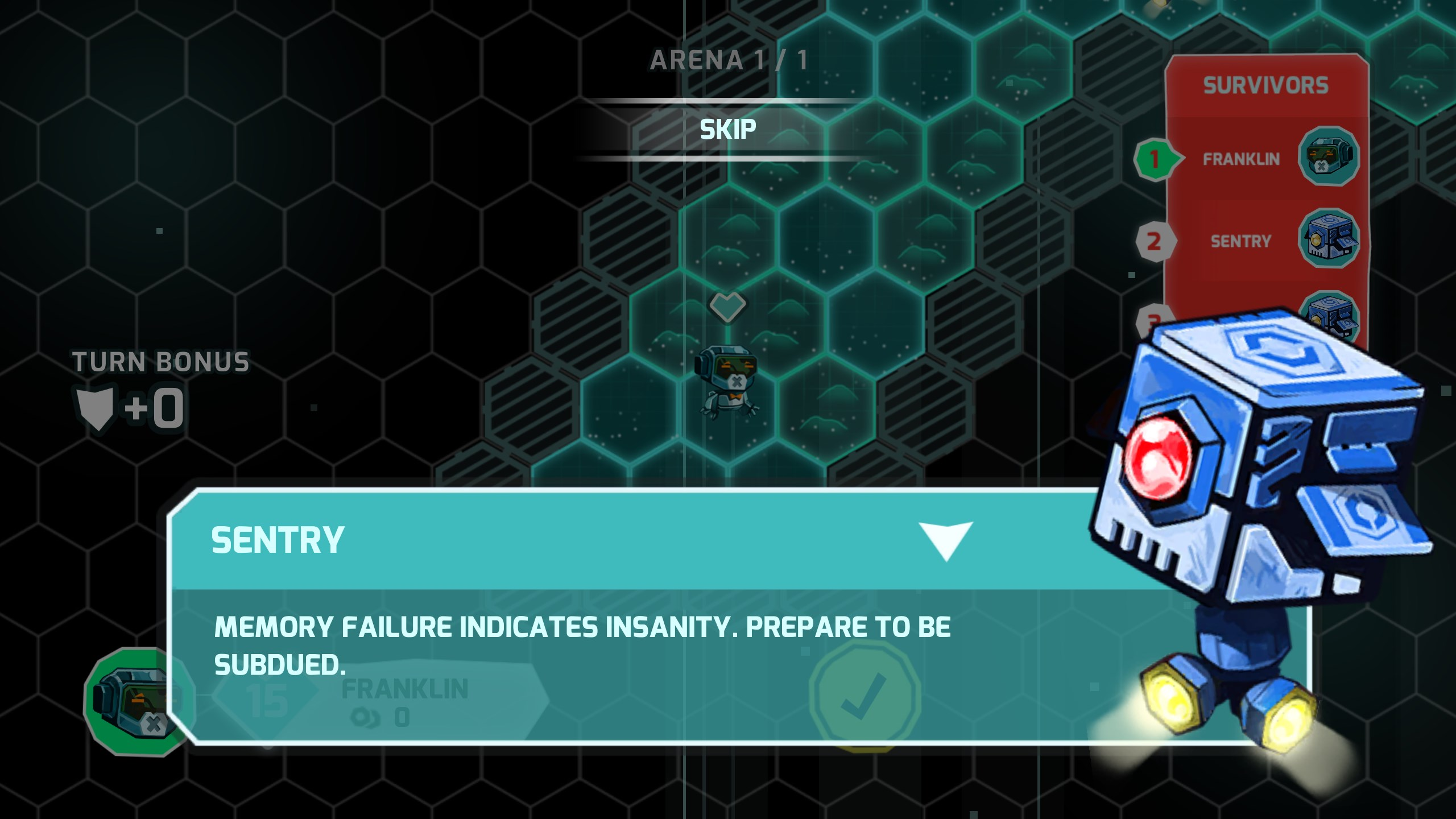
You are Franklin (or one of many unlockable alternatives), a robot with memory malfunctions that has begun asking questions, and robots shouldn’t be doing that. This qualifies as insanity, and insane robots are not considered able to aid humanity. Therefore, you have been ‘selected for volunteering’ into the Arenas, where you do battle for survival against other alleged defectives, because entertainment is now all you are fit for.
The Arenas themselves are hex-based, which feels a bit like Game Boy Wars, if you’re familiar. (The strategy gamers among you probably have a better comparison.) You and other combatants take turns moving around, picking up goodies, entering shops, or encountering random scenarios that may improve your odds in combat. These maps have features such as terrain bonuses or fogs of war that obscure opponents and obtainables.
You can see the hex-grid map that you move around in the background.
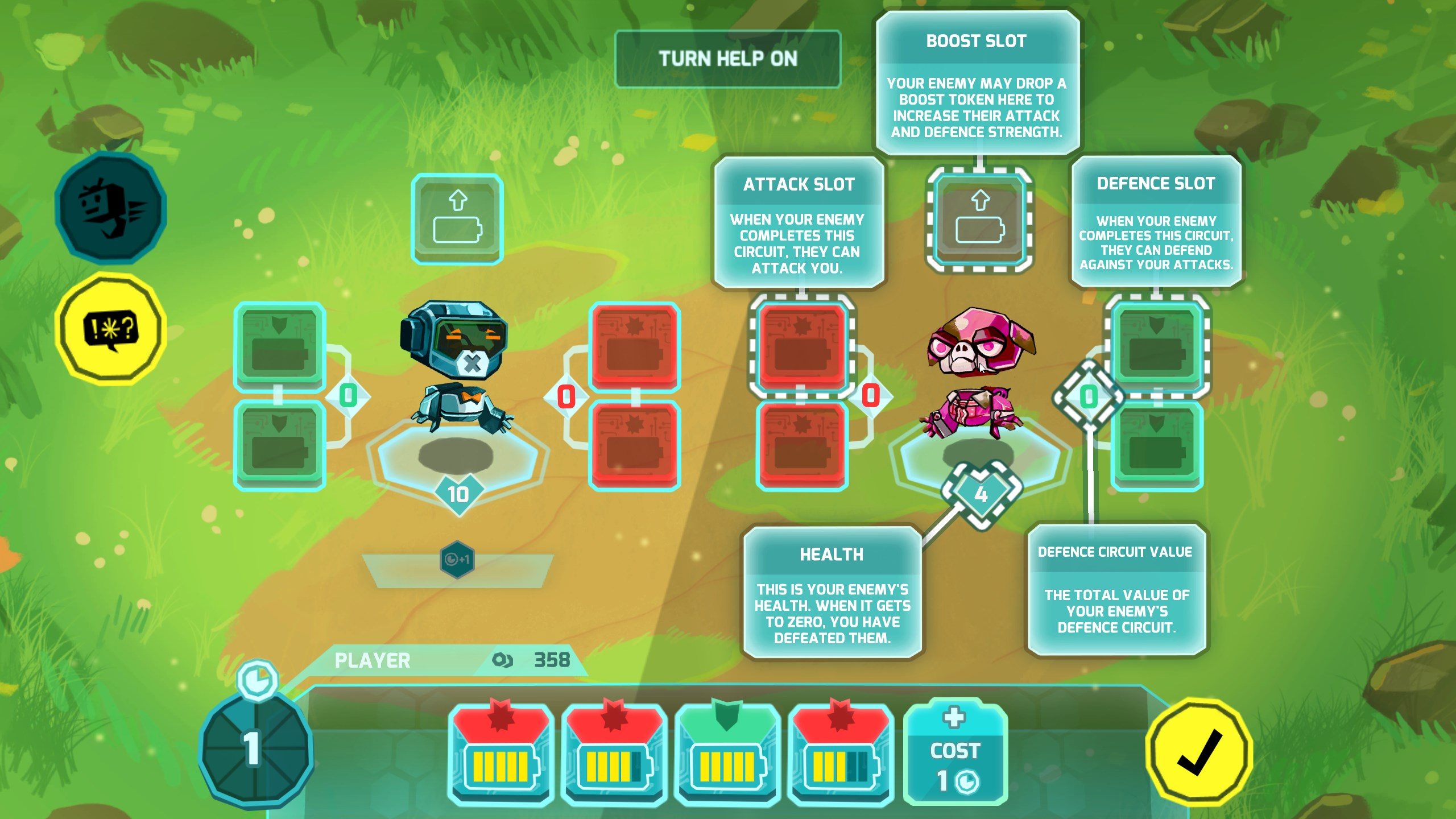
Once you actually run into another robot, battle is joined. At first, it’s business as usual: draw chips (our ‘cards’ in this case) from your deck and use your limited energy to play them. Then it gets wacky. This is a little hard to convey in writing, but you and your opponent have limited slots called ‘circuits’ that you can fit chips into: two for attacking, two for defending, and one for added boosts. The twist: you can’t just, say, drop a chip for blocking three damage into a slot and immediately be protected from the next three points of incoming damage. No, the circuits must be completed – both slots must be filled. For example, put a chip that blocks two points of damage in defence slot one and another that blocks four points of damage in defence slot two and you’re ready to block a total of six incoming damage, but neither one will do anything by themselves.
Once you’ve wrapped your head around that, the madness (insanity, one dares, even) begins proper when you start getting chips that swap the defense or attacking values of player’s respective slots, or randomise them entirely, or lock them off from being interfered with by the opponent, amongst other effects. Because both sides can usually see what’s going on in their opponent’s slots, you are always trying to think a move ahead of one another: are they going to complete that scarily large attack circuit they’re building, or should you just wallop them while they have empty defense slots?
A handy guide that tells you what all the icons you’re looking at do. Can be turned on and off.
Randomised Elements
The interesting thing to take into account is that the CPU opponents have more or less the same ‘cards’ as you, but they also have to move around the hex maps to fight you in the first place. They may not always go straight for you either: it’s quite satisfying to see two CPU enemies go after and whittle one another down while you hide in the shadows ready to ambush the survivor. However, if you’re trying to get the highest score possible (you are rewarded 1-3 stars upon completing an Arena tournament), then it’s in your best interests to be proactive in going after enemies first. HP isn’t restored between fights, so you’ve got to be careful. The amount of money you have left over at the end of each also affects your star grading. This actually discourages spending money on upgrading your ‘bot, forcing you to try to make do with what you start off with. However, this also means you’re partly at the mercy of whatever random paths they decide to move around in on the map. I’ve had more than one tournament where it’s just me and one enemy left and they’ve given me the runaround, spending several turns chasing them around the map until I can reach and fight them.
The types of chips that you draw into your hand each round are random, and the only way to actually manipulate what types you get is to buy robot upgrades (called ‘augments’) that alter the probability of certain types being drawn more often. In this sense, you deck-influence more than deck-build. These augments confer all manner of boons inside and outside of combat, like increasing the likelihood of drawing chips that interfere with your opponent, or raising the number of hexes you can move around the maps. Certain robots come with certain augments right out of the gate, so it’s a case of finding a playstyle you enjoy more than overcoming the unique challenges offered by different character classes. It’s an enjoyable bit of trial-and-error.
‘Overkill’ kicks in when you deal damage to an enemy beyond zero health. You get 100 coins for each further point reduced. More coins = higher ranks.
The only real problem I have with IR is that there is too much push-and-pull in most combat encounters. By that, I mean that the sense that you are winning or losing is switched up on you many, many times before a result is secured, and often simply because of literal luck of the draw. In moderation, this is typically welcome: what would games be without feeling like you’d overcome a challenge or absolutely crushed an enemy thanks to good planning and execution? Unfortunately, this gets exhausting when you’ve been in the same battle for ten minutes and both sides have turned the tables on one another again and again. This gets a bit more dispiriting when you finally win a real knock-down-drag-out fight but have so little health remaining that you are forced to find a repair shop and heal (which will come at the cost of a higher grade/score for this tournament – remember, you’re trying to spend as little money as possible) to reduce the likelihood of getting wiped out in your next battle. I’m willing to concede this could just be a ‘me’ thing though – this genre is nothing if not spoiled for variety in combat pacing, so you may welcome a slower one more than I personally do. The upshot is that the more time spent resulted in a greater sense of achievement when I finally overcame a particularly challenging tournament by the skin of my teeth. Local and online two-player options are included. I couldn’t get the online working, but I imagine having someone else playing to laugh and argue with would go a long way to mitigating the drain of a long combat encounter.
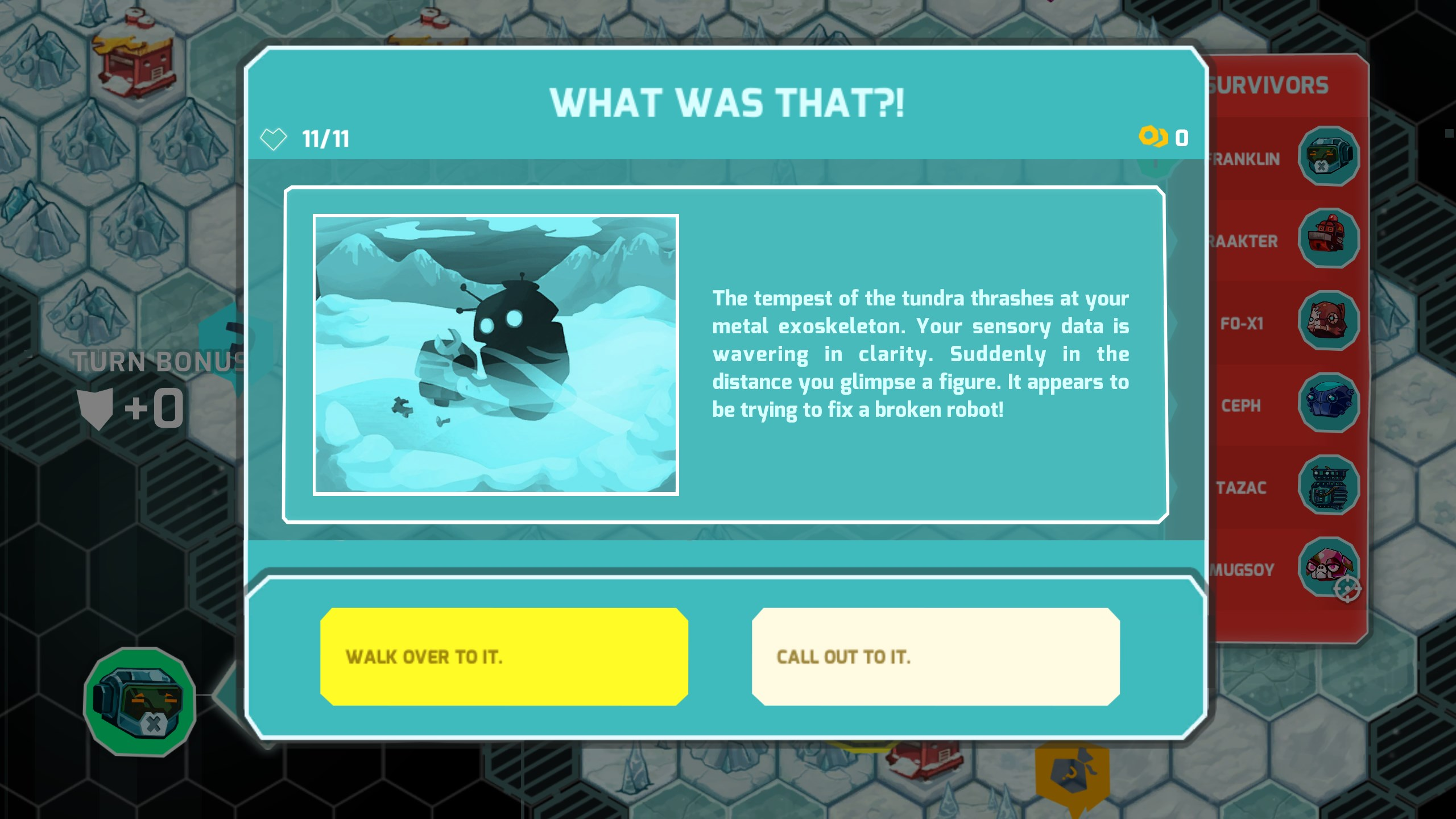
Is it even really a roguelike deck-builder if it doesn’t have these random scenario tiles?
Presentation
The character designs are sweet without being twee, and have a certain bobblehead charm to the way they sway back and forth while attacking or getting attacked. They also have very nice robotic text-to-speech style voice clips when attacking that remind me of the Radiohead song ‘Fitter Happier’. Maps are easy to interpret at all times, and the UI is clean and easy to parse. Little about how the game looks is likely to blow your mind, but it will also never get in the way of your decision-making, which should never be taken for granted.
Special credit to the music, which veers between atmospheric ambient pieces and more appropriately exciting up-tempo stuff when fights kick off. Most of all, I was surprised at how much of it there actually was before I noticed anything repeated across levels, and even then – importantly – very little of it got on my nerves after several loops. In particular, the title screen music is a treat for me as a surf-rock fan.
These little pre-tournament cutscenes are a nice use of the drawn assets.
Closing Remarks
The store page boasts a 15+ hour campaign and I’m sure there’s a lot more to it than that if it gets its hooks in. It certainly reminded me of Advance Wars more than once, and those are fond memories indeed. The back-and-forth of every battle may get wearing or may actually be right up your alley, especially in two-player. Insane Robots is a great example of how surprisingly versatile even just the basic mechanics of the roguelike deck-builder are for a wide variety of genre fusions and story settings.
Standout Augments
Because every robot has the same chips/cards at their disposal, I’m going to use this space to focus on enhancement to the robots themselves that can affect their decks.
Extra grid movement may be a bit dull but makes all the difference. Chase and kill things faster. Run from things faster. Win faster.
Probably speaks more to my own personal playstyle than anything else, but what better way to mess with people than to randomly alter the values of their chips to their detriment?
Of course, it’s no fun when they do it to YOU, so nip that in the bud by locking your chips and preventing interference.
Dream Quest, which I wrote about as the second game of this project, turned 10 on May 14th. Its developer, Peter Whalen of Hearthstone and Teamfight Tactics, was kind enough to give me some of his time and thoughts on July 12th.
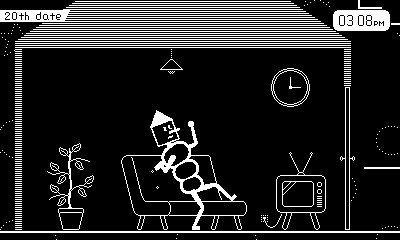
Building block-based narcoleptic Crankin needs your help to arrive late to dates with his extremely tolerant girlfriend. The crank is the only way to interact with the game. Turning it clockwise moves Crankin forward in a manner akin to playing a music box. Turning it counterclockwise ‘reverses’ him. Pacing is key: Crankin’s girlfriend won’t hang around forever, so you will have to be cautious about when you choose to speed up, slow down, or turn back. Between Crankin and the earful he deserves are numerous enemies that cannot be directly defeated, only avoided. The biggest name behind Crankin is Keita Takahashi of Katamari Damacy fame, and it was screenshots and footage of this game that was doing a lot of the heavy lifting for the Playdate when it was being demonstrated pre-release.
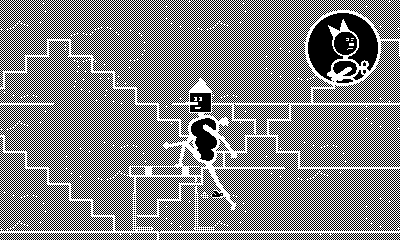
Crankin calls its levels ‘dates’, and I greatly enjoyed the first ten or so. The novelty of the sound effects and stage elements speeding up and slowing down in real time with how quickly you spin the crank never really gets totally old. Unfortunately, the game goes on for fifty levels. The wheels fell off for me in this order. First, the limited view of what’s in front of Crankin’s (very large) figure makes it difficult to see enemies until they’re already on-screen and almost undodgeable, reducing most levels to a repetitive challenge of trial and error. This is a problem people had solved as far back as the first Game Boy with Super Mario Land in 1989, if not earlier: keep your sprites and level elements at a small scale for small displays. Crankin can’t take a single hit from anything, and stepping on dog crap will kill him as handily as getting trampled by a stampeding pack of pigs, so back to the start of the level you go. Second, you realise this is the whole game. I wondered why the official Playdate website categorises this as a ‘Racing’ game, but as I played more I gradually realised that’s a fitting tag. It has a Trackmania or Gran Turismo-esque time attack feel to it, where the only way to get to the end faster is to memorise the order of obstacles over and over again until you do it perfectly. The final nail came when my sense of pride in beating a level immediately evaporated because my reward was always just another, usually even harder, level. I call this the ‘screw you’ gameplay loop. The novelty of new level elements immediately wears off because you’re only beating levels out of spite. I tapped out on Crankin around the 25th date. I’ve stopped talking to more than one person in real life because they weren’t able to stick to appointments way fewer than 25 times, and I’d advise Crankin’s girlfriend to do the same.
Let’s finish with the good, because I found a lot here before it started to grate with me. The visuals take full advantage of it being a Playdate game: completely black, with characters and obstacles being etched with white outlines of varying thicknesses. I’m not sure if I can call something that doesn’t use colour ‘vibrant’, but for a game as full of negative space as this, it certainly achieves a lively whimsy that exceeds what you may expect from the device. In a touch I’ve never seen another game do on hardware orders of magnitude more powerful than the Playdate, the game’s animated home menu icon (an adorable Crankin asleep on his sofa, as he is at the start of every level) seamlessly transitions into the game itself once booted. That’s absolute magic. As with Casual Birder, the Playdate’s powerful sound capabilities are proving to be one of the system’s secret weapons: Crankin has some great SFX, and hearing them get stretched out or reversed in time with the crank manipulation brings back memories of playing records at speeds you shouldn’t. Ultimately, this one had the steepest novelty-to-irritant drop-off of any Playdate game I’ve tried yet, but its commitment to doing things that only this system can do is still to be admired.
Crankin is startled awake as soon as you turn the crank.Get ready to be seeing a lot of girlfriendly disapproval.Our hero majestically times a narrow leap over a walking dog turd.
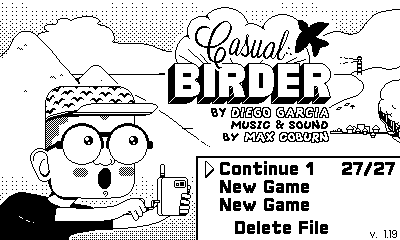
A top-down adventure where you mosey around a town, talk to people, and take pictures in the run-up to a bird photography contest. In contrast to the arcadey Whitewater Wipeout, this one is more of what we might expect from a modern indie game: a tone, a well-executed gimmick, an afternoon’s worth of gameplay, and a special little world that doesn’t overstay its welcome or feel underexplored.
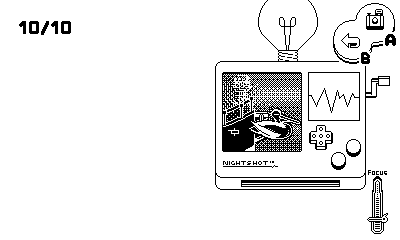
Let’s get reductive. It’s a 2D Pokemon Snap demake with its tongue in its cheek. Your character moves into a new town and receives a little birding encyclopaedia to fill. There’s even a rival team to roadblock progress. With only 27 birds and being a strictly single-player experience, there’s only so much to be done. That’s grand, because the little journey is packed with love and silliness. The crank’s main function here is to focus your phone’s camera to take better shots of birds. This doesn’t get old, mostly because the game usually creates puzzles around locating the birds themselves rather than requiring any particular dexterity or timing with the picture taking. This was absolutely the right call.
My previous post said that Whitewater Wipeout didn’t do much to plant a unique flag for the Playdate in the gaming landscape. This is the other game available in the first week of Season One and it helps the system’s case significantly. It makes me wonder if instead of the crank or the minimalism that comes about from the hardware’s (mostly intentional) limitations, the Playdate’s unique selling point may be irreverence. Just a moment before you leave. WW has its surfer dudeisms and makes light fun of the player’s failures with a you-suck tone you don’t often see in non-indie games. I can take or leave that. Casual Birder, however, wouldn’t be anything without its sense of humour. There’s cheeky NPCs, over-the-top character portraits, and nebulous, exuberant flavour text. This kind of self-awareness is always at risk of making a game feel dated or too-clever-by-half, but CB mostly sticks the landing by piling great little moment upon great little moment until it’s over and you have several screenshots of smiles it brought you to look back on.
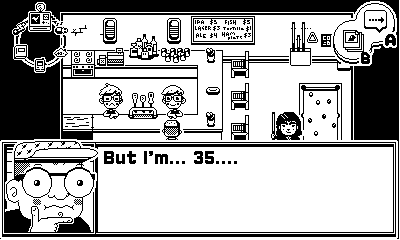
To rattle off these instances would be to rob you of the fun of coming across them yourself, so I’ll just share one as an example. One bird can only be found if you repeatedly litter in a coffee shop, annoying the barista until they literally throw you out with the trash… which attracts a bird to snap. More generally, the game’s presentation is phenomenal. The Playdate must have an impressively high pixel density to be able to pull off the different shades of darkness in caves. It reminds me a little of World of Horror, or how PC-98 games would achieve amazing colours and detail through dithering. Squint in houses and marvel at the surprising detail, like posters with miniscule writing and tiny desk decorations. NPC character portraits are sometimes so expressive and detailed they bring to mind Phoenix Wright defendants melting down. Max Coburn’s music (a.k.a Maxo… brought back good memories of Cool Games Inc.) sounds almost like a parody of videogame music, but with such solid, jaunty funk that it remains catchy long after the gamey novelty disappears. The tone captures Casual Birder as a whole: a short, cheerful videogame thrilled to be a videogame. A great fit for a system that seems itself intended for short, cheerful experiences.
Finding every bird is very doable.That chalkboard has a menu, I promise!The night camera shows off some impressive 2-bit graphical trickery.











 Shrunken Shrine