Casual Birder (Playdate S1 #2)

Release: September 15th, 2021

Developers: Diego Garcia, Max Coburn

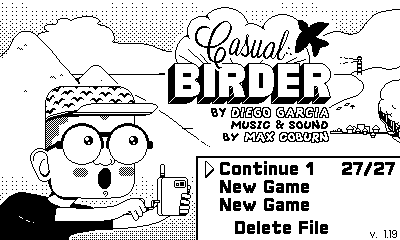
A top-down adventure where you mosey around a town, talk to people, and take pictures in the run-up to a bird photography contest. In contrast to the arcadey Whitewater Wipeout, this one is more of what we might expect from a modern indie game: a tone, a well-executed gimmick, an afternoon’s worth of gameplay, and a special little world that doesn’t overstay its welcome or feel underexplored.

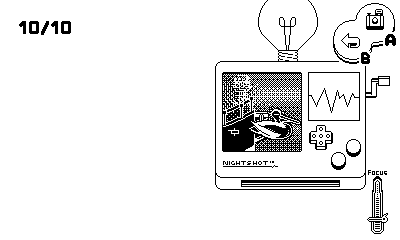
Let’s get reductive. It’s a 2D Pokemon Snap demake with its tongue in its cheek. Your character moves into a new town and receives a little birding encyclopaedia to fill. There’s even a rival team to roadblock progress. With only 27 birds and being a strictly single-player experience, there’s only so much to be done. That’s grand, because the little journey is packed with love and silliness. The crank’s main function here is to focus your phone’s camera to take better shots of birds. This doesn’t get old, mostly because the game usually creates puzzles around locating the birds themselves rather than requiring any particular dexterity or timing with the picture taking. This was absolutely the right call.

My previous post said that Whitewater Wipeout didn’t do much to plant a unique flag for the Playdate in the gaming landscape. This is the other game available in the first week of Season One and it helps the system’s case significantly. It makes me wonder if instead of the crank or the minimalism that comes about from the hardware’s (mostly intentional) limitations, the Playdate’s unique selling point may be irreverence. Just a moment before you leave. WW has its surfer dudeisms and makes light fun of the player’s failures with a you-suck tone you don’t often see in non-indie games. I can take or leave that. Casual Birder, however, wouldn’t be anything without its sense of humour. There’s cheeky NPCs, over-the-top character portraits, and nebulous, exuberant flavour text. This kind of self-awareness is always at risk of making a game feel dated or too-clever-by-half, but CB mostly sticks the landing by piling great little moment upon great little moment until it’s over and you have several screenshots of smiles it brought you to look back on.

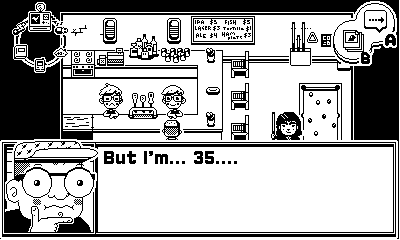
To rattle off these instances would be to rob you of the fun of coming across them yourself, so I’ll just share one as an example. One bird can only be found if you repeatedly litter in a coffee shop, annoying the barista until they literally throw you out with the trash… which attracts a bird to snap. More generally, the game’s presentation is phenomenal. The Playdate must have an impressively high pixel density to be able to pull off the different shades of darkness in caves. It reminds me a little of World of Horror, or how PC-98 games would achieve amazing colours and detail through dithering. Squint in houses and marvel at the surprising detail, like posters with miniscule writing and tiny desk decorations. NPC character portraits are sometimes so expressive and detailed they bring to mind Phoenix Wright defendants melting down. Max Coburn’s music (a.k.a Maxo… brought back good memories of Cool Games Inc.) sounds almost like a parody of videogame music, but with such solid, jaunty funk that it remains catchy long after the gamey novelty disappears. The tone captures Casual Birder as a whole: a short, cheerful videogame thrilled to be a videogame. A great fit for a system that seems itself intended for short, cheerful experiences.

Whitewater Wipeout (Playdate S1 #1)

Release: February 19th, 2021

Developer: Chuhai Labs

An arcade-type game where you use the crank to try to keep your surfer on the waves as long as possible while doing tricks to score points. Really, that’s more or less it. Most of my interest in Whitewater Wipeout comes from the pause it gave me about what it means to be a system’s first game.

You get two games every week in Playdate’s ‘Season One’. This is likely the first one of the two you will play because it shows up first in the system menu. I mentioned in my last post that the Playdate feels like a Game Boy with its limited inputs and small monochrome display. For many, that system is synonymous with its pack-in game, Tetris. Easily understood and infinitely addictive, Tetris kicked the door open not only for people who didn’t have the time or living scenarios for console or arcade gaming, but people who didn’t even know videogames were something they’d like. There’s a generation of people for whom the medium begins and ends with Tetris. From cartridge one, the Game Boy’s place in history was assured.

Not every first pack-in game can change the world like Tetris, but I’d say it should function as something of a mission statement for its system; showcasing its strengths or what it brings to the medium. Sonic the Hedgehog deliberately and directly kicked sand in the face of a particular market competitor with graphics and speedy scrolling that their rivals Nintendidn’t have. Wii Sports was the ideal demonstration for how the Remote could intuitively remove the most obtuse roadblock for non-gamers, the controller. Whitewater Wipeout is here to tell me that… the Playdate has an analogue crank. Perhaps developer Chuhai Labs (incidentally, run by Giles Goddard of Star Fox development fame) didn’t know that their game would be the first thing most Playdate owners would play. Maybe they had no input in how the Season One schedule got rolled out. It’s a solidly built toy of a game that does one thing and just one thing very well, but it feels like a shortsighted first pick.

On first impression, I wrote a pretty dismissive and now-deleted tweet where I basically called it a tech demo, and I bounced off of it within 15 attempts to keep my dude on his board for more than a minute. While the crank felt great to spin, WW didn’t show me how it could be a gateway to exciting new or exclusive experiences, or like it was solving a problem I’d had with other systems. Had my Playdate not had firmware issues that required an assisted factory reset, I’d probably never have touched it again. I’m glad I did though, because somewhere around my thirtieth or so attempt, something clicked. Like the first time you don’t fall off your bicycle immediately, I was able to keep my surfer on water longer than a few seconds. I was in the pocket. The inertia was mine. I understood. The trick was to launch off waves and make sure that the board’s nose was pointing directly back down. It was a simpler, less potent version of that rush you get when the music starts playing for a few seconds consistently in QWOPI’m doing it! I’m doing it! I’m actually doing i– ah, well, I was, for a moment there. One more try… 


Soon enough, I was doing triple-360s like they were nothing, able to keep my surfer up as long as I was giving it my full attention. But to what end? Getting higher scores. The online leaderboard, predictably, has scores so astronomically high I wonder if the runs that they were earned on are counted in minutes or hours in duration. Tetris, too, is a high-score beater, but the mass appeal lies in the randomisation and the tangible sense of improvement, making bigger plans and gambles in anticipation of future blocks. That’s a very different form of reward from WW, where high-level performance feels like pulling off a string of sick fingerboard tricks. You’ll enjoy it as long as you find the momentum and rhythm of skillfully using the crank enjoyable. For me, that was about 90 minutes. For you, it could be less or a lifetime.

Playdate

In July 2021, I pre-ordered a Playdate, promptly forgot I did so, then moved to another country. We’ve all done it. I was finally able to pick it up this January. I set it up, charged it fully, and it crashed repeatedly, presumably in disbelief its neglect was at an end. Customer service was able to provide me with a utility program that reset the device, and I’ve had no problems since. After several rain checks, I was ready to go on my Playdate.

To catch you up, the Playdate is a bright yellow gaming handheld with an unlit black-and-white display. The system is about half the size of a modern smartphone. D-pad, two face buttons. So far, so Game Boy, but the big twist is an analogue crank. Think like the bit on a fishing rod that you use to reel a fish in (apologies for the technical jargon). Upon registering your system online, two games are automatically unlocked as part of a ‘Season One’ of games, with a further two made available each week. In addition, there’s an online store where more games can be bought, and the system is open-source, so games and homebrew can be sideloaded by USB.

It’s a great bit of furniture. Whack the purple cover on it, put it on a table, and someone will ask you about it very quickly indeed. While there’s no backlight, the LCD screen is much like that of an e-reader. You’ll need an external light source, but you shouldn’t be having to crane your body around to keep away glare like we did back in The Good Old Days. I’m not sure what the resolution is exactly, but if you’ve got your reading glasses on, some games are able to pack in some surprising amounts of detail and remain legible. Unsurprisingly for something that was developed with the involvement of Teenage Engineering, the single speaker has a real punch on it when turned up, but you know what? Even this thing has a headphone jack on it. Everything should still have headphones jacks on them. Machines that don’t output sound should have headphone jacks. I will never not be angry about smartphones that don’t have one. It’s a lovely looking bit of kit, though it’s probably not going to worry your Switch or Steam Deck for things to play. What can you play on it, though?

This was originally going to be a Twitter thread going through the games, but I thought this system and these games do deserve at least a little bit better than the kneejerk reactions to media I usually toss out on there, so here we go. All the dignity that blog posts can afford. Join me, won’t you? Yes.

Shrine Offerings #2

Break? I’ve been here the whole time! This one’s been on the stove since… well, the last Shrine Offering. I can now guarantee these will not be coming out with any regularity, but I don’t think that’s bad news. This video was ready over a week ago (and was even 2-ish minutes longer), but getting it through the YouTube copyright checking took a further ten or so tries. Re-edit, re-render, re-upload, re-fail. At some point I’ll write in more detail about how that actually impacted the final thing for better and worse. Suffice to say, playing copyright claim whack-a-mole is not part of my idea of creative fulfilment or time well spent. Anyway, I’m really itching to get back on the deck-builders, so you’ll be hearing from me sooner rather than later. In the meantime, enjoy!

Coin Crypt 10th Anniversary Developer Interview with Greg Lobanov

Coin Crypt, which was the first entry in my Roguelike Deck-building Game chronology, turns 10 years old today. I’m delighted to present an interview I had with its developer, Greg Lobanov (Chicory: A Colorful Tale, Wandersong) on November 9th. I’m no natural-born interviewer, but Greg gave insightful answers, and I’m proud that how meaningful this was to both of us comes across as strongly as it does.