RDBG #11: Slay the Spire (2017)

Here we go, The Big One. If you’ve played only one game featured here, it’s extremely likely to have been Slay the Spire. If you have enjoyed almost any other game in this subgenre since its release, it likely owes inspiration (a little more than just ‘inspiration’, in some cases) to Slay the Spire… or at least the nerve to take the plunge in bringing something similar to market following its success. Indeed, this is the roguelike deck-builder’s Super Mario Bros. or Doom moment: others of its kind existed before it, and by certain criteria it has been surpassed, but here is a perfect storm of great vision and execution that guarantees its place in gaming history.

Slay the Spire was released on Steam Early Access on November 15th, 2017 by American dev team Mega Crit (incidentally in the news recently for coming out against Unity’s ludicrous per-install engine usage fee). With the majority of its core gameplay locked in, the game was given regular bug and feature patches up until January 23rd, 2019, at which point it was released for computer platforms. Far and away the most financially and critically successful game we are likely to ever look at here, it is now available for most modern console platforms and mobile. It now even exists in physical board game form… surely the greatest sign that you’ve ‘made it’ as a, er, video game.

Premise and Gameplay

Your first run will start the exact same as your thousandth. Pick one of four character classes (the latter three are unlocked over time) and away you go to see Neow, a whale-like creature that guards the spire entrance and offers you a choice of blessings, such as raising your maximum health or upgrading one of your cards at random. Your run to reach the spire’s top is split into three acts, with each ending with a boss fight. Your paths to these bosses branch, offering a variety of scenarios. There are midboss battles (here called ‘elites’, a term that seems to have stuck for other such fights in roguelike deck-builders), shops, rest areas that allow you to heal or upgrade cards, random events that may help or hinder, and the like. Some of these are signposted well in advance of you reaching them, while others are randomised, so you are able to look ahead and plot whatever path to the boss you feel may be the most beneficial. You may know you have an elite fight coming up soon, but you won’t know exactly what enemy you’ll be facing, so you may want to choose an alternate (if less rewarding branch) where possible.
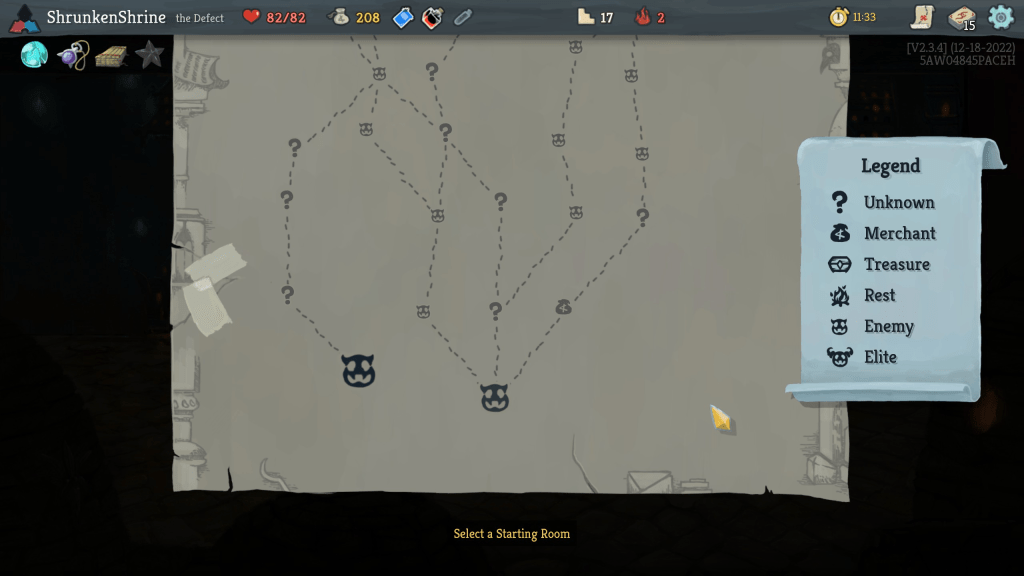
As you can see, you’ll have a general idea of what you’ll be in for, but not specific enemies or events.

We’ve already seen earlier games with both more choice and diversity in their character classes, but StS’ Ironclad, Silent, Defect and Watcher are so tightly designed and well-executed that they are genre all-timers. (I mean, bias notwithstanding… I’m writing this wearing my shirt that features all of them, aren’t I.) The Ironclad is a high-risk, high-reward fighter option, often committing to high-damage builds that often jeopardise their own health. The Silent offers more of a health-whittling, death-by-a-thousand-cuts approach. These are certainly the two that you’ll be wanting to wrap your head around the basic run flow with, but the other two aren’t that much more impenetrable – they just have greater complexity and depth.

The Defect and the Watcher, who were added later after initial early access release, are surprisingly unique and deserve more detail. The former is a robot that can stockpile ice, electric, or dark energy to either provide or block chip damage every turn, or spend it all at once in order to strike or avoid decisive blows. The latter, my personal favourite, is a monk who can switch in and out of three different stances – Calm, Wrath, and Divinity. Calm allows you to shore up card-playing energy (think Magic mana). Slipping into Wrath forces you to deal and receive double damage, so making sure you have cards in hand that take you in and out of it before the turn passes to the enemy is vital. Divinity grants you an extra 3 energy to play cards with *and* lets you deal triple damage without the fear of double-damage that comes with Wrath, but takes far longer to reach than the other two states. Indeed, all of these playstyles are so unlike one another that it almost feels like you’re playing a different game, but for none of them to feel even remotely inferior to any other (besides whatever your personal preferences are) is incredible. 

There looks like a lot happening in this picture, but the game has a wonderful flow – and you can take all the time in the world to deploy your actions optimally.

Randomised Elements

Compared even to other games that came before it, StS actually feels a lot less random, and I think this has actually helped it endure in the long run. You are likely to come across certain enemies almost every run, but because your deck build will have changed, you are forced to approach them in new ways. Another thing is that most of the classes only have three or so main ‘builds’ (several variations and derivatives are possible depending on circumstances). The Silent, for example, is likely to be stacking poison on their foes or drawing and playing many as many low-damage shivs as possible. As such, you are better able to form builds earlier in runs. I think this has actually added to the game’s longevity with streamers and speedrunners. The curve of learning what your enemies and cards are capable of doing is gentle and engaging, and even masters of the game who seemingly know every ramification of every scenario like the back of their hand keep coming back for more with self-imposed challenges and a healthy modding scene.
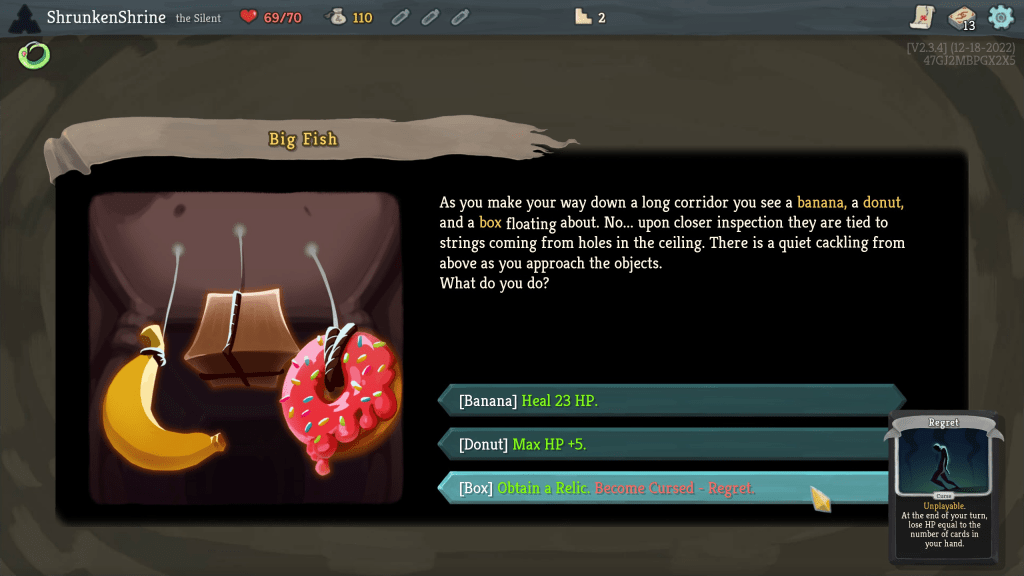
A simple humour and joy comes through in the event scenarios.

This nicely leads me into the game’s capacity to add difficulty modifiers, called ‘Ascensions’. Completing a run with the first Ascension active (which simply adds more elite battles) unlocks the next Ascension (regular enemies deal greater damage). The wrinkle is that these stack upon one another, all the way up to Ascension 20, by which point you’ll be laboring under all manner of handicaps, such as decreased maximum HP, limited inventory slots, or mandatory unplayable cards cluttering your hand. There are people out there who are capable of beating the game at ‘A20’ with a starting deck of only eight mid-tier cards or speedrunning it in 5 minutes. None of these feel like poor design, either. Like many RPGs (and unlike competitive CCGs), working out ways to break the game over your knee is simply another valid way of enjoying it, if you’re into that. Make no mistake though, you’d have to be really bloody good.

I’ve heard it said that at their core, a video game’s enjoyment factor can be boiled down to the quality and frequency of meaningful decisions you can make during your time with it. I find that a tad reductive, but it must be said that pretty much everything you do in StS is a meaningful decision that comes with a tradeoff. Do I drink this potion now or later? Which of these boss rewards should I take? A surprising way you can bring this game to life is to grab a friend (not even necessarily one who knows how to play) and try to ‘co-op’ a run. Revel in how it suddenly takes either of you ages to work up the nerve to actually commit to a play as you argue the merits of every playable card in your hand and come closer to understanding the tightness of the design. Marvel at how situations you’d mindlessly click through and potentially misplay when alone suddenly need you to crack out the whiteboard to justify the potential consequences a turn or two from now. Complexity does not always equate to depth, and depth does not always equate to fun. Slay the Spire isn’t the most complex or deep game we’ll ever look at here, but I contend it always stays fun.

Ascensions are picked at the same time you choose a class, but you must have cleared the previous difficulty level in order to access the next one.

Presentation

Slay the Spire was never a knockout in the looks and sound department (excellent character design aside), but it oozes with a premium Flash-era charm with its gently-animated enemies and backgrounds. There isn’t exactly what I’d call lore to it, but the way it’s been designed gestures toward the notion that there’s a lot more going on in this place than is explained. Who are these hook-wielding cultists who dress as birds? What happens to our brave heroes after slaying the spire? You won’t get any answers, but you probably won’t want any, you’ll be too absorbed in the game itself.

You can find out what every single thing in this shop does at a glance without a single click. They can all be moused over for further detail.

The card design and artwork is nothing short of phenomenal. This is what every card-based computer game should aspire toward. Clear, legible, tonally appropriate fonts. Mechanics that can be clearly understood as keywords, and cards that can be moused over to bring up a tooltip for a reminder of what those mechanics are. Cards that rarely contain more text than 15 words. Artwork that reduces nicely to smaller displays and retains legibility. It’s all here, it’s all textbook. For a laugh, if you want to see how important good artwork can be to these games, it is possible to unlock and switch to ‘beta art’ cards that look more like the MS Paint-style cards of Dream Quest. A bit of credit is due to the UI as well: if you haven’t played it, these screenshots likely look extremely busy, but in a game with a lot of stockable and stackable mechanics, the icons, counters, and timers are very easily read and understood without being intrusive.
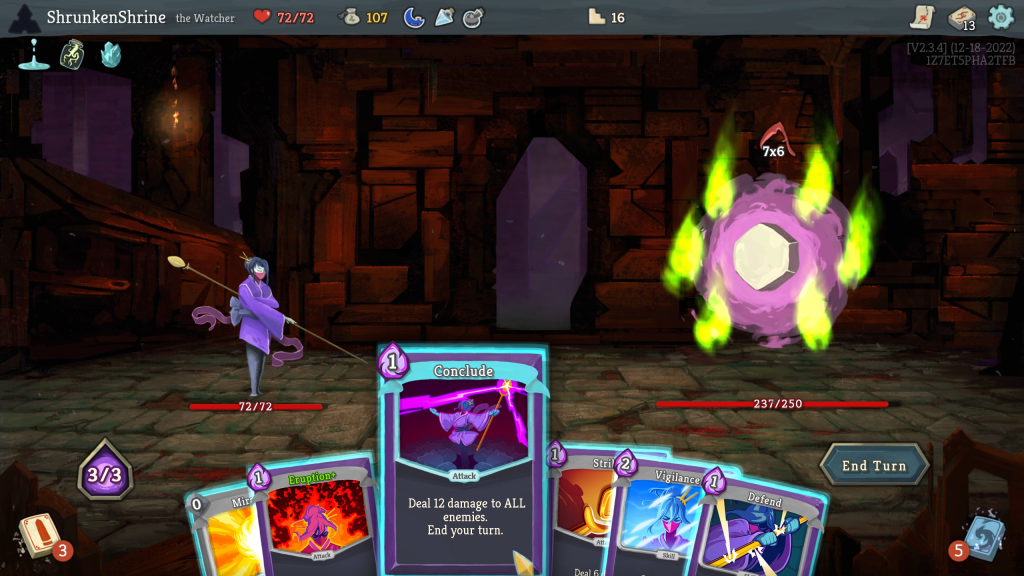
 

End-of-act bosses often enter with worrying amounts of health, and become tests of how well your deck can keep you safe, not just how fast it can kill normal enemies.

Closing Remarks

Slay the Spire could be both the starting and end point of your exploration into the little corner of gaming that is the roguelike deck-builder. (Obviously, I would hope you would stick with me a little longer, but you’d get the majority of all you’d need to know here!) Here’s a story that’s just about the most ringing endorsement I can give it. A year or so ago I was recovering from deviated septum surgery, which is where they basically widen one of your nasal cavities to help you breathe. Really, I should have just tried to sleep as much as possible, because staying awake through two nostrils full of constantly bleeding gauze is something you want to be awake for as little as possible. I had a Switch full of major releases I hadn’t started and an e-book full of unread stuff that this would have been the perfect opportunity to catch up on. Instead, I bought a second copy of StS for my smartphone and just started from the beginning. The hours melted away for next few days. It did a far greater job of keeping the constant discomfort out of mind than the copious painkillers.


Less anecdotally, StS could be the perfect gateway into the broader genre of CCGs without the hassle of buying physical cards and tracking down people willing to teach you the basics. The mobile/online versions of the big names like Magic and Yu-Gi-Oh! leave a lot to be desired for a number of reasons, and exist mostly to hook people into their respective franchises rather than serving as spaces for people to get a feel for if the genre is ‘for’ them in the first place. When you buy StS, there are no booster packs or metagame mechanics to worry about. Immediately accessible, easily understood, infinitely enjoyable. A credit to videogames.

Standout Cards

When I said earlier that this is a tightly designed game, one example is that you can actually feel the rigorous playtesting throughout. There aren’t a million cards in it, and most of them only do two things at most, but they are extremely well-considered and versatile puzzle pieces. YouTube has countless tier lists of what experts consider the best cards to be, with a surprising lack of consensus. This suggests a remarkable balance that caters to a wide range of playstyles. With that in mind, here’s one I like for each of the four classes:

The Ironclad is often in situations where in order to hit big, they are going to suffer big, too. Feed, then, presents an interesting mitigation dilemma: do you prolong a fight in the hopes you draw this to finish an enemy and get more HP, or just try to kill them now and get it over with?
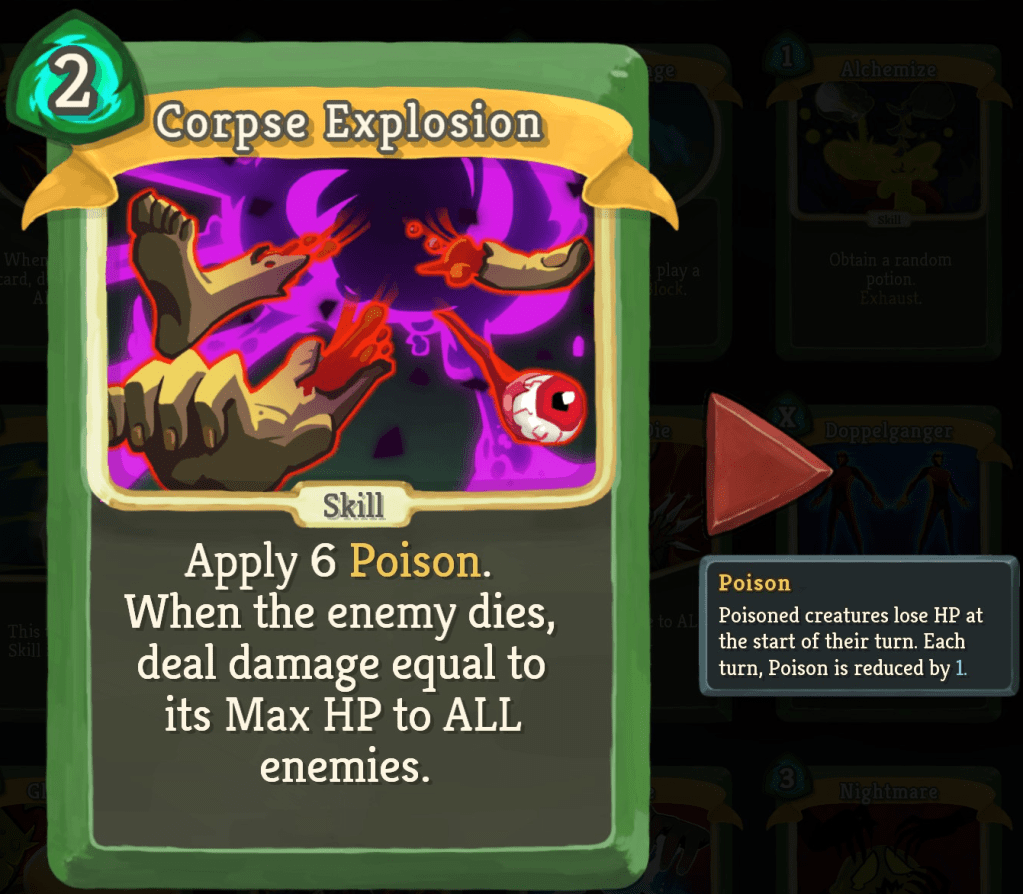
Hilarious when you pull it off, this Silent card encourages you to target the tankiest thing in the room in the hopes it obliterates the rest of your enemies when it checks out.
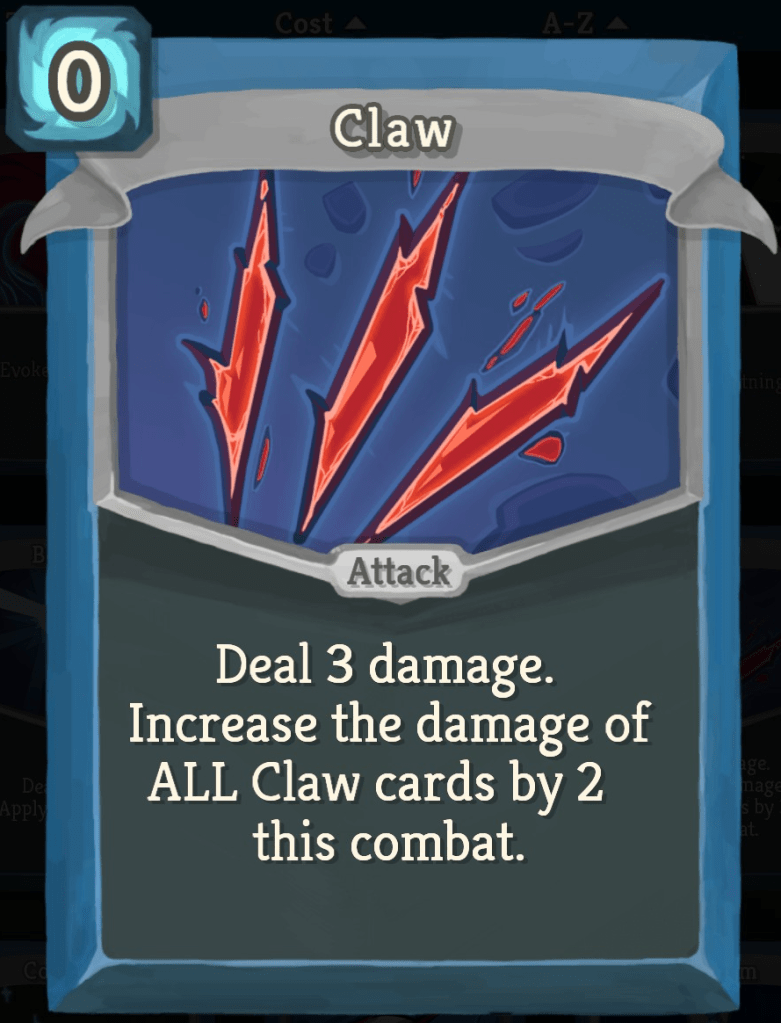
Claw is a bit of a meme. The Defect is a character whose playstyle is based around careful juggling of various resources. Claw ignores these, costs nothing to play, and boosts any other Claws you may have. Consequently, the Claw deck player spends their run in demented pursuit of finding and playing as many Claws as they can. Simple-minded lunacy or high-risk-high-reward discipline?
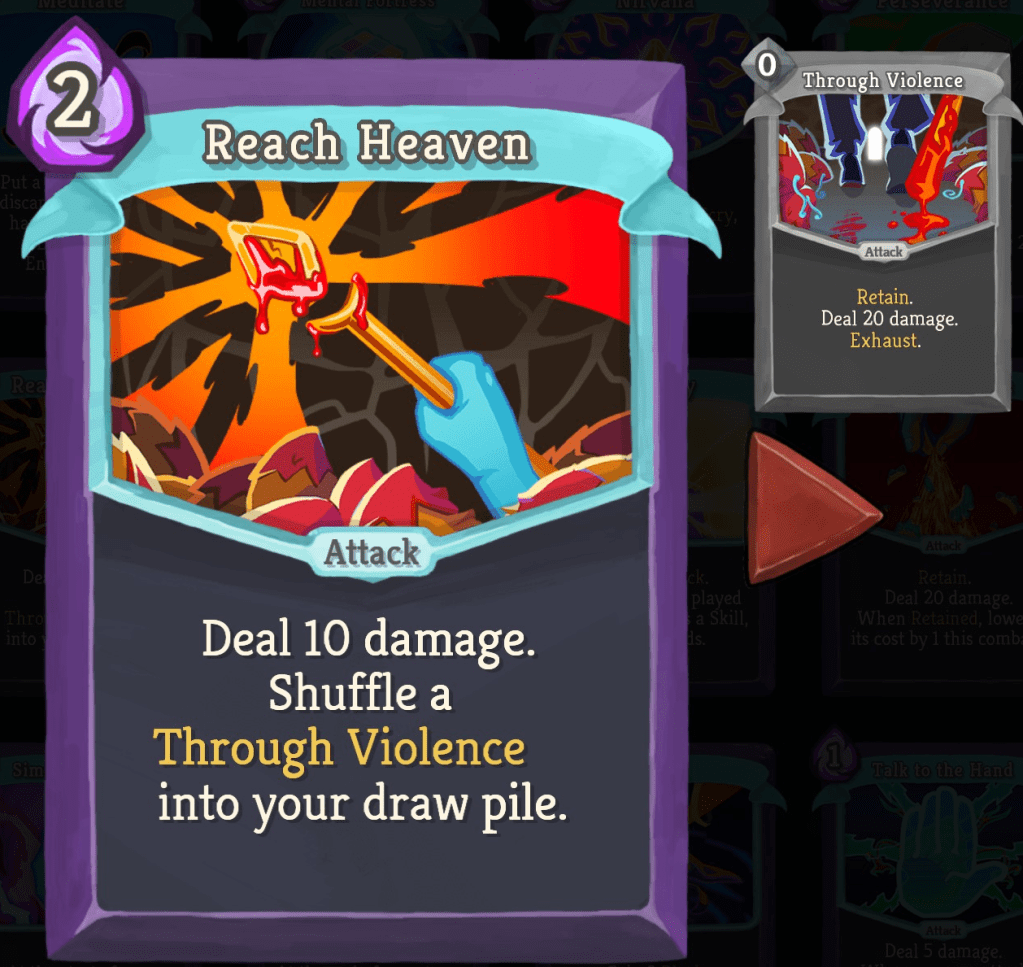
Look, I had to pick one that just looks and sounds really cool. Reach Heaven is best paired with a Watcher who is in a position to soon enter the double-damage-dealing Wrath stance, so that when they draw the (free!) Through Violence on a future turn, it does an unspeakable 40 damage, even though the card is immediately destroyed.

RDBG #10: Hand of Fate 2 (2017)

Released on November 7th, 2017, Hand of Fate 2 is the first direct sequel we’ve seen to something covered here. Unbeknownst to me at the time of writing about the first game, it is also Australian dev Defiant Development’s final game – the company went defunct in July 2019. Founder Morgan Jaffit has chalked their closure up to a failure to adapt to the changing nature of the game market and the risks taken in making their games. Ultimately, it sounds like the games weren’t selling enough to recoup what they were spending on making them. This is deeply unfortunate, because the Hand of Fate games are some of the most polished and graphically impressive things we’re likely to see in this genre, and the refinements made to the game’s formula make it easy to recommend over its already enjoyable predecessor.

Premise and Gameplay

Largely being an enhancement of the first Hand of Fate’s formula, I will not go back over much of the background in my post on the first game. In brief, the Dealer, having suffered his first loss at your hands in the first game, returns to narrate your traversal through “22 paths of wisdom and despair”. As before, you navigate your way around a card-based game board, managing resources and equipment as you make choose-your-own-adventure style story decisions and fight enemies in real-time action rather than turn-based card combat. Rather than collecting and playing cards during a run, you select a pool of cards you may or may not come across during the run, affecting the equipment and scenarios you will encounter.

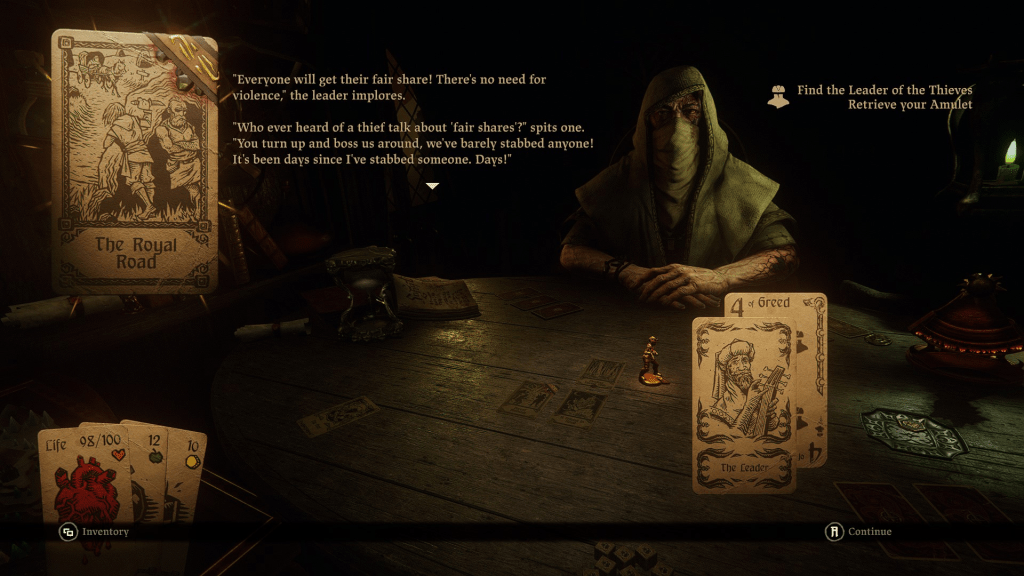
He’s back, and he’s not best pleased. He will, however, let you choose to be a woman this time around.

The biggest modification is the expansion of the concept from simply surviving a run to taking risks through exploration. The object of the original game was to endure movement around the board long enough to get to the next floor, eventually reaching and defeating a boss. Exploration is now encouraged by walling off access to the boss until certain criteria are met. There are different extents to which runs can be completed, as well. Many will deem you successful if you rout the boss, but extra rewards can be obtained for completing all the objectives.

You aren’t adventuring alone anymore, either: you can have a companion alongside you. Companions offer a variety of support, such as using ranged magic or acting as a secondary melee attacker to draw enemy attention while you focus on walloping someone else. Enemies now have different resistances and weaknesses to certain equipment, and you can even unlock further benefits from your weapons by using them a set number of times in a specific way. This helps to mitigate a problem with the previous game where equipment choice was almost always a no-brainer exercise in sticking to the weapons and armour with the highest stats.

New enemies, bosses, and even your own character when you enter a fight with new equipment trigger a splash screen with a few details.

Combat is still melee focused and feels a little more responsive this time around. Little icons appear if an enemy can be hit with a special or finishing move, which I’m grateful for because it used to be easy to forget to ever use them and just hammer the normal attack button if things got hairy. You will likely still do a lot of that anyway, but with the greater variety in enemy types, you are encouraged to at least think about changing your approach from time to time. Your character still does the thing where they will ‘slide’ toward the nearest enemy in range if you press attack but you aren’t close to anyone, as though ice skating in their direction, but it isn’t as egregiously obvious. I don’t think it does anything particularly innovative or exciting to sell you on this style of combat if you aren’t already a fan of it, but I think credit should be given that this is still a novel form of engagement for this early in the genre.

Other improvements may not be apparent unless you played the original. A big one for me was the moment I noticed that travelling over previous-visited spaces no longer consumes food, enabling exploration greatly. You can now camp at any time to restore health and trade for items, but the risk of running out of food and starving remains. On the whole, a greater amount of important decision-making is on offer at any one time, and that’s usually a good thing.

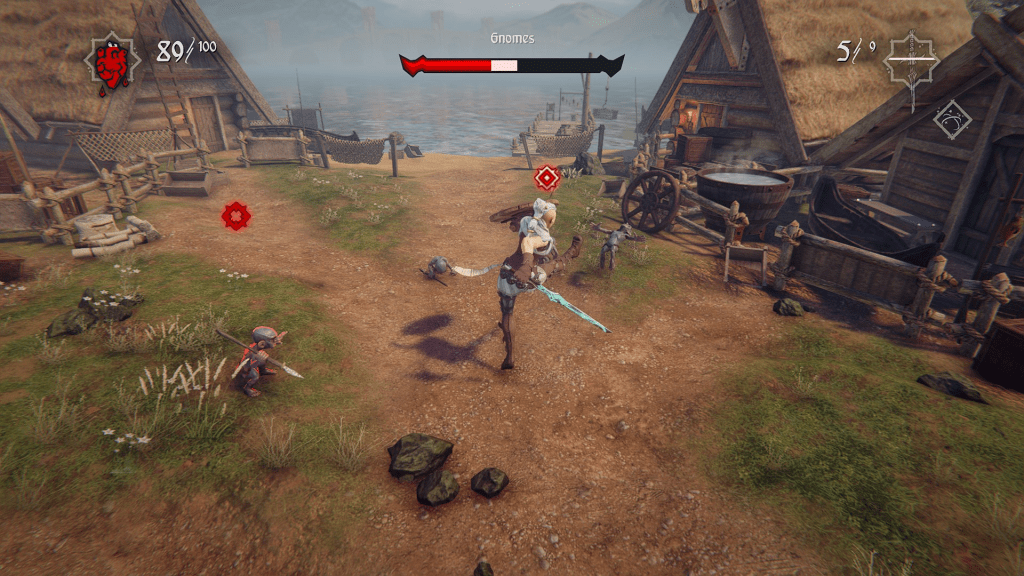
Hilariously, the ONLY way to defeat gnomes is to kick them in the face.

Randomised Elements

Not a whole lot new on this front, but there are two things I deem worth bringing up here. The first game had a bit of a difficulty issue whereby 85% of the campaign missions could be fairly easily blasted through on your first try if you were good enough at the action combat and were careful with your equipment, until the last two or three missions stonewalled you by making you likelier to come across bad cards that sapped your health and resources, leaving you in poor stead for the boss fight. This has been addressed by rebalancing the difficulty curve. I started getting game overs around the 5-6 mission mark, but these were rarely things that couldn’t be overcome without a little more thought about rebuilding my deck and a second try. By endgame, you are spending a good bit of time before a run choosing exactly what you hope to come across in your deck instead of just hitting the ‘Recommend’ button and hoping for good RNG, as it now makes more of a difference.

The tone of the first game remains in tact – equal parts grim and grimly funny.

Another feature that I think may be more controversial is the addition of more purely luck-based minigames on top of the random success-failure cards from the first game (which also make a return appearance here). The most curious of these is a dice game, where you roll three dice and must beat a certain number for a positive outcome. This is novel the first time you play it, but because the only action you can take if you fail is to reroll one dice, it quickly becomes uninvolving. I can think of an easy way that this could have been improved: have the Dealer roll against you (perhaps within a certain range) and have the result of his roll hidden until you make your own, not unlike rolling against your DM in a Dungeons & Dragons campaign. Perhaps there was a development reason they wanted these instances to have a definite hard-set number you must pass, but as it stands, there’s little engagement to it, especially as you can’t quit partway through.

Presentation

It’s hard to tell in static screenshots, but a lot of care has been taken to liven up enemy encounters and locations. Enemy typing is a lot more diverse now, and I’m happy to notice that the lighting has better direction now, meaning you can get a much better look at the models now. Your own character’s appearance and clothing is now even partly customisable. The font is less ye-olde-traditional looking, but it is much more immediately readable, which is definitely the right call to make for a text-heavy game.

It gives me great pleasure to report that the last enemy defeated in a fight will still ragdoll away from you in slo-mo, now accompanied by VERY over-the-top victory music.

The vocal performance of Anthony George Skordi as the Dealer is once again the standout here. I honestly think the HoF games would only be half of what they are without this character, and that’s very unusual for a genre that lives or dies by its gameplay mechanics. HoF2 is a great example of how a little bit of good writing goes a long way to keeping someone coming back to a game, and the Dealer’s voice samples invite you to consider the worldview of the game beyond what’s simply written on the cards. At times aloof and condescending while always waxing philosophical, he seems to equally delight and despair when you overcome his challenges. Lines like “I never understood the duel. If you’re at war, use every tool at your disposal. If you’re not, let things lie” give you a bit of a window into his mindset but he’s every bit the enigma he was in the first game. I also noticed a bit less repetition in his voice clips between runs, which greatly helps his credibility as a ringleader overseeing your whole journey.

Jeff van Dyck returns on the OST, doing a spectacular job staying within the tone and motifs of the first game while expanding on the instrumentation. Voices, wind instruments and acoustic guitars get more of a look in here. Surprisingly, some of the tracks border on Zimmeresque bombast. Defeating any encounter brings with it an almost deafening celebratory blast of synthy horns. I’m personally delighted that winning a run brings with it a new but equally exciting guitar piece while you pore over the spoils you can carry into future runs. I’m going to make a point of looking into other games purely on the basis of his scores.

RNG minigames return with greater variety, if varying quality.

Closing Remarks

It saddens me to think that this is perhaps the last we’ll see from Hand of Fate as a series. I think 2 came very close to perfecting its formula. Having said that, given how hyper-competitive the indie space is, perhaps we should be grateful it even got a sequel with this much love and refinement to begin with. There’s three packs of DLC I have yet to dive into. Quite honestly, I actually would like to keep them to one side as a treat. I know that it’s only a matter of time before I will get the itch to challenge the Dealer once again.

Standout Cards

Cards in HoF2 are significantly more involved than their predecessor. As such, the compendium doesn’t offer up full details of a card’s dialogue or functions – those surprises are saved for the game itself. The compendium simply shows how cards can affect a run mechanically.

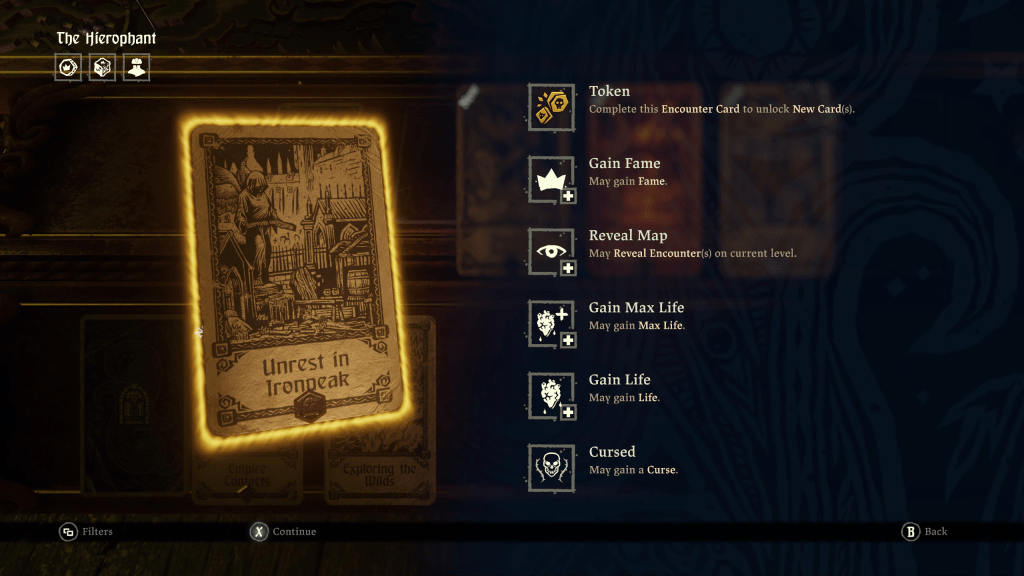
Unrest in Ironpeak probably demonstrates this best. I’ve kept it in my deck every run I’ve been on and still haven’t unlocked its ‘completion’ token. As you can see, if can confer up four different boons and one literal curse, but in order to see everything this card does, you would need to satisfy four different requirements in four different runs.
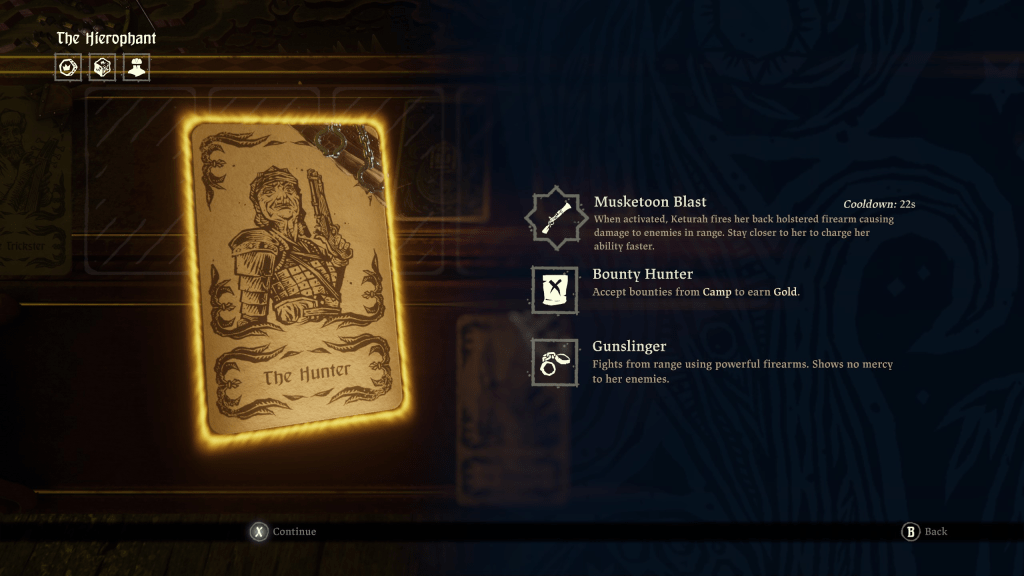
Companions are a new addition to HoF2. Keturah of The Hunter card is my favourite. Not only can she fire at things from a cooldown, but her bullets also pierce through multiple enemies, which is great if you can line them up.
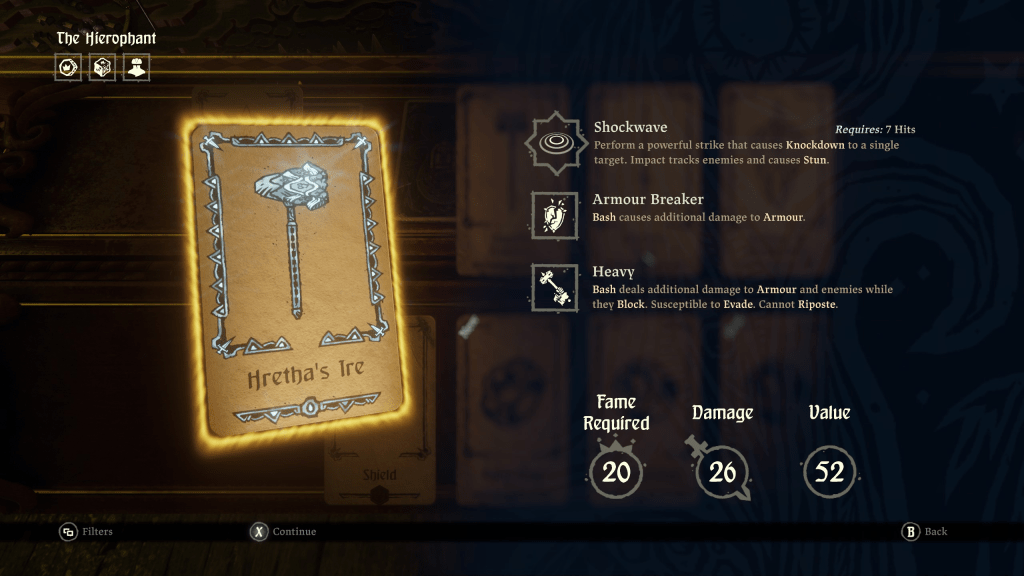
Even with the action combat, there is no one universally ‘good’ weapon. Different enemies carry different resistances, and while there’s a lot of smaller, nimbler things you’ll come across that can handily evade Hretha’s Ire here, the shockwave and fast it can smash through things that give most other weapons a lot of bother is very satisfying.

RDBG #9: Monster Slayers (2017)

Monster Slayers has a little history that goes beyond even the earliest-released game we’ve looked at on this blog. Its roots lie in a 2010 browser game on Kongregate with the same name, which you can play for yourself here. Mechanically, this 2017 overhaul (released on March 23rd) doesn’t have a lot to do with that earlier game, despite some surface resemblances. While it does share a good deal of that Newgrounds-era Flash charm in its character designs, the original had none of the deckbuilding, so I’m not going to be making any further comparisons between the two. Both were developed by Malaysian one-man-studio Nerdook Productions. We’ve seen a good few small-team games in this chronological series already, but in terms of raw features and content, Monster Slayers is fairly staggering in its scope.

Premise and Gameplay

Monster Slayers isn’t too big on story, as you may be able to surmise from its rather plain title. (I don’t want to rag on it too much, but as game names go, my eyes just slide over the words Monster Slayers and they do not stick in my brain.) Start a file, choose a class for your character and a handful of cosmetic elements affecting their appearance, and away you go to clobber evildoers and explore dungeons. In addition to the roguelike deck-building, the game also wants to give you the added gradual joy of developing a character, not unlike how you would in classic dungeon crawlers like Wizardry. Your character can come across bits of equipment, level up, and gain companions with abilities you can trigger to help your party leader out of tight spots by drawing new cards, blocking incoming damage, and so on.

Being able to redraw your initial hand if you don’t like it is still something you don’t come across often in this genre.

Strengthening your character is as key to your chances of surviving a run as the cards you gather. Similar to Dream Quest (which openly receives an acknowledgement in the title screen), the dungeon maps show you a few locations around where you currently are, allowing you to plan the order that you take on enemies. You can fight things of similar or lower level for safer battles, or you can take on something higher level to get more experience points and level up sooner. Levelling up also restores all of your health, which doesn’t automatically regenerate between fights, so this can be something fairly integral to consider. You will take on three dungeons before fighting the final boss, so even choosing the order you want to clear the maps is important. For example, if you have a fire-based card or two, it’s probably in your interests to do the ice dungeon sooner than others because the enemies are more likely to be vulnerable to those attacks. Your main character is likely to be strong against a handful of enemy types and weak against certain others, so developing a sense of which enemies your class is going to struggle against over multiple runs also becomes part of the strategy.

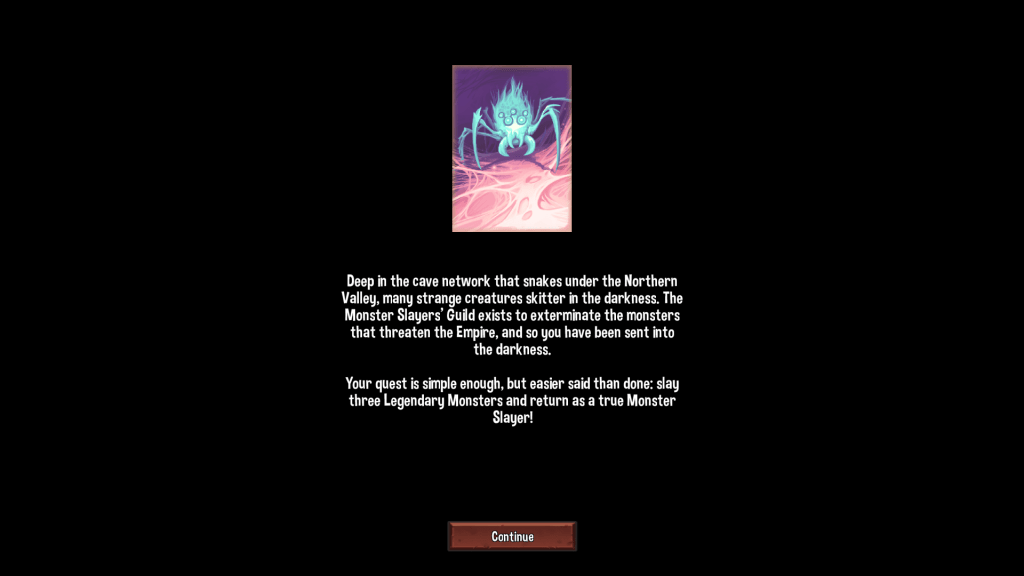
In perhaps another nod to Dream Quest, you get a random bit of intro text upon starting a new run.

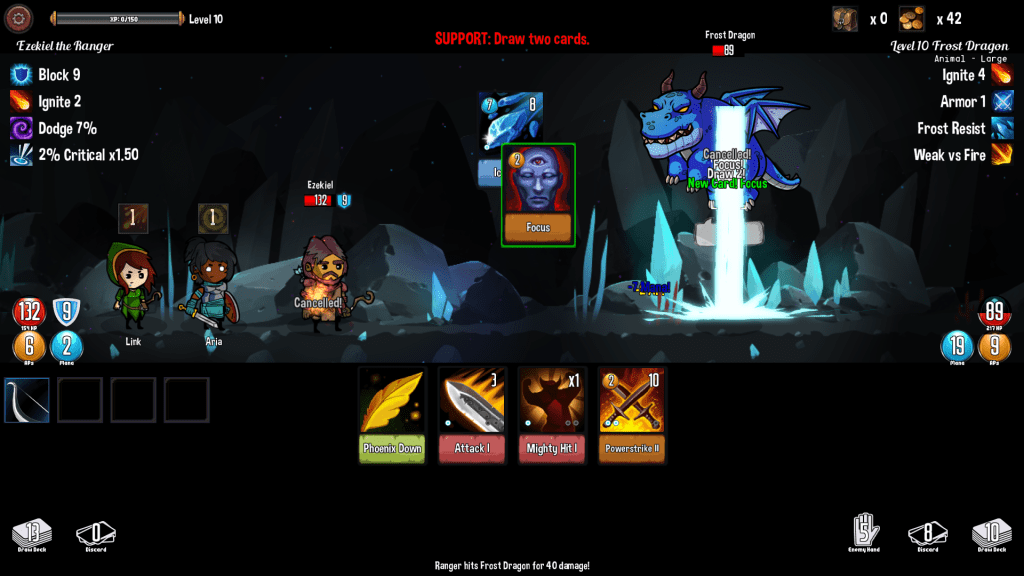
Combat? Take turns choosing the best possible cards from your hand and hope it’s not you who stops moving first. There’s a lot of plates to keep spinning that you need to keep an eye on. Besides health and blocking points, there are two major energies to keep track of, mana and ‘action points’, which are required to play magic and action cards respectively. Wizards will be more reliant on stockpiling the former rather than the latter, whereas clerics may want to balance both so that they have access to various spells and standard attack cards. There are a lot of classes here, too: 14 of them, with 6 being ‘base’ classes, 6 being ‘advanced’ unlockable variants of those 6, and then a further 2 that come with the Fire and Steel DLC pack. In fact, you can even pay to unlock the advanced classes if you so desire, but doing so could rob you of one of the largest incentives to beat the game in the first place. Further to this is weaponry and armour that not only change your character’s damage resistances and output, but even the cards in your deck. If you like your deck-builders to be fairly granular in their systems, this is probably the most involving one we’ve looked at yet.

Ah, yes, Pot of Greed.

Randomised Elements

Monster Slayers has randomness for days: the enemies you can encounter, the rewards you can choose upon levelling up, the cards, items and upgrades that healers offer, and the order you take on the dungeons… all these and more are different every time. Given the genre, it’s redundant to trot out the ‘no-two-runs-the-same’ selling-point line, but certainly we’ve seen games that feel very similar run-to-run even if they’re not literally repeating themselves on a move-for-move basis. Monster Slayers can feel radically different every run. This is good, because I don’t find it an easy game, so having the variety between runs kick in early stopped me from getting bored fighting my way back to the point my previous run ended. Obviously, different classes lend themselves to alternative playstyles. If you enjoy playing as a Wizard, for example, you may find that the big ‘kill’ card in your deck is different each time and needs to have certain elements in place to be triggered: enough mana, an enemy with certain weaknesses, and so on. Physical attackers like the Barbarian won’t be waiting around for certain cards because all of their attacks will do heavy damage – unless, of course, an enemy resists physical, which will require a backup plan of some sort.
Equippables aren’t always straight upgrades to your stats – they may add an extra card to your deck that you might not want.

A little credit I want to give in an area where randomness is noticeably absent: the player themselves has a good bit of input in the rewards they unlock between runs. Upon a run’s end, players gain ‘fame’ points based on how far they progressed and how many enemies they fought. (This also functions as a placement system for players to participate in an online leaderboard.) These can be spent on unlocking things like new cards, equipment, and passive advantages for future runs. The nice thing is that you choose each reward yourself. If you prefer to play as the Knight, then you need only buy perks that affect the Knight or all the classes in general, rather than being rewarded with boons for classes you aren’t as interested in.

Lots on offer to fit your playstyle and shape future runs.

Presentation

Definitely another one of those games that you will know immediately from a few screenshots whether or not it is something you can put up with looking at for several hours. I’m old enough to remember spending afternoons after school watching Flash animations on Newgrounds that looked a lot like this. I look at this and it gives me a little nostalgia that I appreciate won’t be the case for everyone. Most of the characters look like souped-up stickpeople – take them for what you will.

The UI puts a lot of the information you may need in front of you at all times. It’s a little cluttered, and the font sizes are a bit small, but because combat turns play out very quickly (not a bad thing from a time-saving perspective) you may need access to all this information at any moment. Another minor irritant is that it doesn’t always tell you what cards do in every context. For example, if you visit an altar, you may be able to gain a powerful card in exchange for some downside, like enemies being buffed. Unfortunately, there’s no way to know what the card does until you pick it up. Hovering over the name of the card won’t provide you with a tooltip or anything. Sadly, this means I’m almost never inclined to take these exchanges because not having access to the information you need to come to a decision makes it too random to be worth doing.

Altars also offer hints about the next boss’ weaknesses or resistances.

In my time with the game, I would say that I heard roughly 10 or so minutes of original music in it. With dozens of hours of gameplay if it gets its hooks into you, you may want to switch it out with your own after a while. It’s faux-orchestral bombastic fare; thematically fitting as background noise but not melodious enough to lodge in the memory. Something about the synthetic quality of the music in combination with the hand-drawn art certainly does add to the general uncanny sense that you’re playing an extremely well-developed Flash game, despite obviously being far more mechanically complex than anything Flash could run. It feels like I should be using a proxy site to get around an URL blocker on the school computers just to access it. Good times.

Closing Remarks

I have an inkling that, years from now, when this project is a few dozen or so posts deep and I start winding down on it, Monster Slayers is one of the games that I’ll come back to first so I can more fully take in the enormity of its depth. I found myself taking too much time thinking about each round, but that’s on me. Ultimately, the only thing that matters is maximising your chances of drawing your best cards as often as possible and always having the requisite resources to play them. However, because there is a lot of minutiae you can take advantage of, I sometimes lost sight of that and would get paralysed by my own decision-making process. Still, that’s hardly the game’s fault, and I look forward to coming back for the many stones I’ve still left unturned.

Standout Cards

Choosing just three cards isn’t easy, as there are four major card types (attack, support, magic, and interrupt) and many are upgradeable, but hopefully these three provide a taste of the level of depth going on here.

Interrupt cards are ‘trap’ cards’: they remain unplayed in your hand and are triggered on the enemy’s turn. Enough! essentially places a hard limit on the enemy’s turn and puts you in better stead on your own.

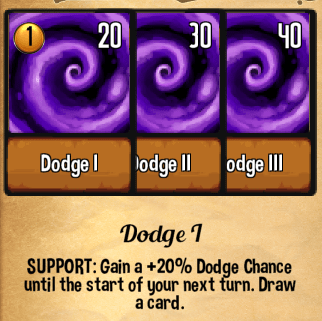
One of the most interesting things about Monster Slayers is that it lets you choose to do the math on incoming damage to block it or use cards like Dodge for a percentage chance of avoiding damage entirely. Certain classes lean into one type of damage reduction more than the other, but a combination of both is also feasible.
Some support cards are Swiss army knives. For 3 action points, Versatility provides one of three radically different effects. You may prefer a thinner deck with multi-effect cards like this, or a bigger deck with stronger individual effects.

RDBG #8: Card Quest (2017)

This one required a little digging to find its earliest availability. Even as a fairly young medium, video games are notoriously poorly archived, compared to books or film. Modern accessibility for older titles is one thing, but even just getting a solid date on the earliest release for an indie game that is only 6 years old at the time of writing isn’t always as easy as you may assume. According to Mobygames and Steam itself, Card Quest was released on November 7th, 2017. However, early tweets from two-man developer WinterSpring Games link to reviews that received early copies of the game. One such review states that it was available through early access on Steam from January 20th, 2017. The reason I’m posting in order of these early access release dates is because I would bet that the majority of the traction for these indie games came as soon as they were out (regardless of how ‘complete’ they were), especially during the immediate post-Slay the Spire boom we will soon reach. After all, Slay the Spire itself received over a year of hype between its early access and ‘official’ releases, so I’m going to extend that consideration to other games, too.

Premise and Gameplay

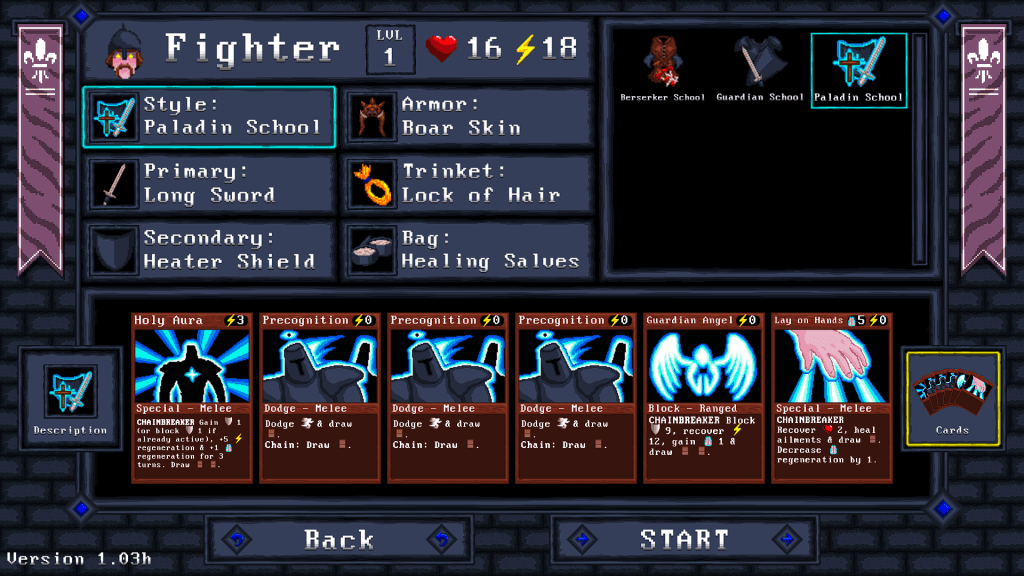
Card Quest actually has multiple settings. There are three scenarios, all loosely bound by a fantasy theming. The first, City of the Undead, sees you trying to rout a zombie plague that has taken hold of some villages over a single night. The second, Dwarven Mountains, has the player helming a throne reclamation attempt on behalf of an exiled dwarven prince. Lastly, ‘Enchanted Forest’ is a hunt for a legendary beast through a forest maze. Each of these little scenarios is played out with a class of your choice. Stop me if you’ve heard this one before: you can choose from a rogue, a wizard, a fighter, or a hunter. As usual, class choice largely dictates what kind of deck you’ll be running around with. Rather than altering your deck as you progress or unlocking new cards between runs, you make direct changes to your character’s loadout and background (here called a ‘school’), a little like you would with a Dungeons & Dragons character. For example, at the start, your Fighter class can only come from a ‘Guardian School’ background, which revolves around blocking as much damage as possible. Later, you can unlock things like the high-risk-high-reward Berserker School or the dodge-focused Paladin School, each of which adds a new set of special cards that interact differently with the class’ base cards.

They may be pixelated, but there is a surprising amount of grotesquery in the enemy sprites.

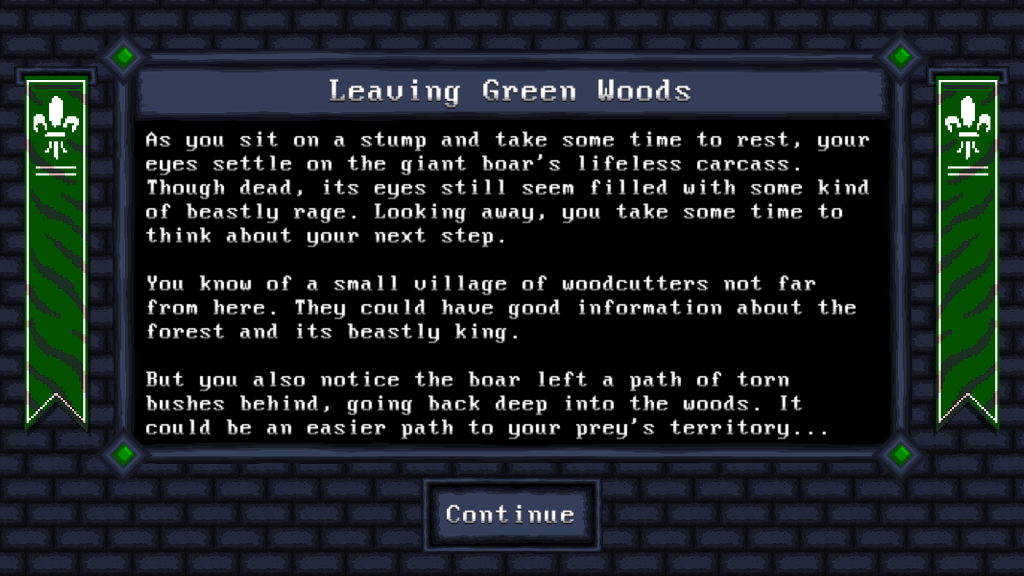
Each class has an individual tutorial that plays out not unlike a series of puzzles. They tend to only have one intended solution as a means of introducing you to the unique mechanics of the class you’re currently using, but it can become pure trial-and-error if the trick isn’t immediately clear. I question their value as tutorials because unlike actual runs, you instantly fail them for not adhering to a very narrow range of accepted moves, but I suppose they do force you to solve them in a way that makes you aware of unique ways to deal or block damage. They are still worth completing because they unlock additional trinkets that provide effects in combat, as well as a little bit of dialogue from a mentor figure. We know very well by now that this isn’t a genre particularly held back by a lack of worldbuilding, but it’s nice to get a little whenever you can find it.

By the strictest possible definition, the game barely qualifies as a ‘deck-builder’. You can only change up your cards if you take up one of the few mid-run opportunities to change your class school, as described earlier. On the one hand, this does mean you never spend any time worrying that your deck is too thin or thick. Many cards allow you to draw more cards as a secondary effect, so there is fun to be had in getting a cycle going, keeping space in your hand, drawing new cards, and balancing the energy (here called ‘stamina’) needed to play them. 

Clearing an area after winning several battles will net you a bit of text setting up the next part of the story. Very adventure gamey.

There are two major elements to Card Quest’s gameplay that distinguish it from other games we’ve seen so far. The first is that individual cards are extremely powerful right from the start, and are not upgraded in any typical way. Whereas most deck-building games keep their cards relatively simple, only performing one or two actions simultaneously, Card Quest’s cards are relatively complex, with many providing a varied mix of damage dealing, blocking, dodging, resource building, card drawing, etc. Unless you change your class background mid-run, you will be using the same slim deck of cards throughout the whole run, with multiple copies of several of them. The second standout is the ‘chain’ mechanic. Many cards behave differently if you play them after another card in the same turn. For instance, the Hunter’s ‘Move Away’ card usually just allows you to dodge one incoming attack for a cost of 3 stamina. However, if you have already played a card that turn, its additional chain effect is triggered, reducing its stamina cost to 2, pushing enemies back one row, and allowing you to draw an extra card. Such powerful secondary effects compel you to think carefully about the best way to manage your hand. 

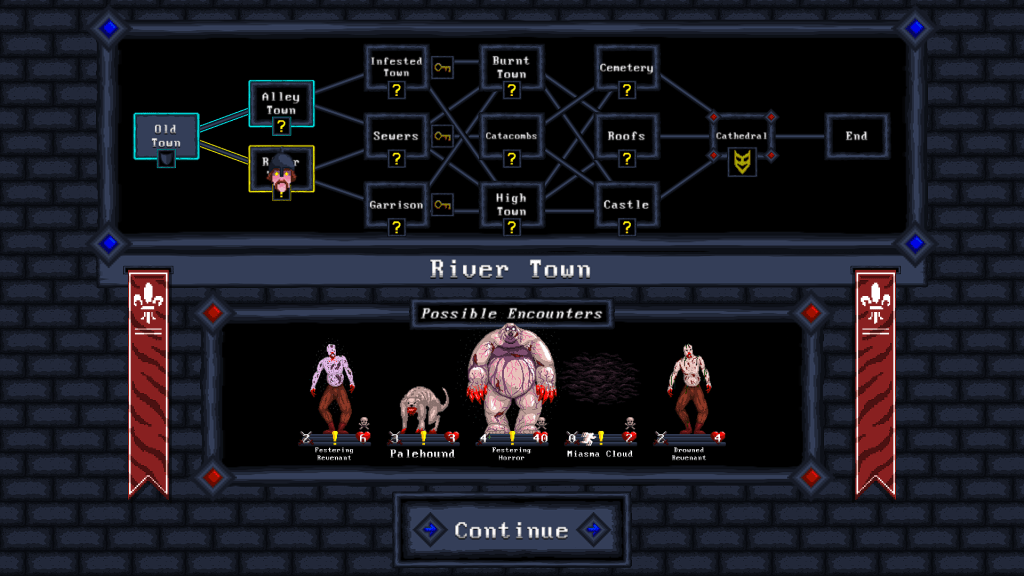
Interestingly, finding all three keys (by taking alternate paths in different runs) will allow you to start the run further in. I can’t tell if presenting the removal of the early stages to the player as a reward is a good thing or not. Doesn’t this suggest that there isn’t much to the early game that can shape your run?

Randomised Elements

Honestly, there isn’t a whole ton of randomness between runs. You can chart your usual path to the boss from an overworld map, and these let you know what types of enemies you are likely to encounter through several back-to-back fights in that area. The greatest randomness you are ever at the mercy of is trying to work out how far you are from drawing the cards you need. Cards in your hand are retained between turns, but you can only have five at any one time, so discarding what you don’t need in the hopes of seeing it again in a couple of turns when you do need it becomes part of the strategy. Enemies, particularly bosses, can be quite fiendish, with multiple attacks and defensive strategies. Several have passive dodge abilities, meaning they can’t even be hit unless you have certain cards. It is hard to feel like you have bad luck when you have so few types of card in your deck to worry about, but it does mean you will be wanting to switch up your class and school often to keep things fresh.

Choose your path to the final boss, complete with warnings about what you may face along the way.

Presentation

By 2017, pixel-art nostalgia was definitely back in full force among indie games, but a number of them tripped up where it mattered, failing to maintain readability of action and information. Fortunately, Card Quest doesn’t trip over its shoelaces here in its pursuit of looking like an RPG running on an Amiga. The use of windows to partition enemies, resources, and other parts of the UI bring to mind things like Dungeon Master. Enemies inhabit the screen’s top half and your hand occupies the bottom. Critically, given how mechanically busy the cards are, the pixel font is legible and of a decent size, so you’re never squinting to make out what something does. Likewise, the card art is well done, but more importantly, distinctive enough in colour and design for you to choose things at a glance without mistaking them for something else, assuming you remember what they do. To nitpick, animations can’t be sped up, and they can take a second or so longer than you’d really like. That adds up over the course of a run, especially when you’re in the pocket and your brain is a card or two ahead of the strategy you’re trying to put in place, but you’re still waiting for that archer to just hurry up and shoot you.

Changing your school of training or equipment will change your cards. Trinkets and bag items can be triggered for an effect like health or stamina replenishment, but have cooldown periods.

The music probably gave me the fastest laugh I’ve ever had out of a videogame. This won’t matter to anyone except myself, but I cracked up when I booted the game and was immediately met with “Five Armies” by royalty-free music legend Kevin MacLeod, a song that I have associated with the mad competitive eating challenges of LA Beast for at least 10 years now. That’s neither here nor there, but when else am I going to bring that up? All the music and sound effects seem to be from free libraries, and besides the aforementioned novelty of whatever associations you may carry from hearing them elsewhere, they’re completely serviceable and unobtrusive.

Closing Remarks

Card Quest initially seems deceptively simple and narrow in its range of cards and gameplay styles, but it offers one of the most immediately compelling ‘flow’ states that I’m always searching for in a gameplay loop when I start up a new roguelike deck-builder. When I’m playing the Fighter class (my personal favourite), I’m able to get into an almost solitaire-like zone – discarding things I don’t need to keep space in my hand to draw more cards that will allow me to dodge instead of block which will allow me to save more stamina which will allow me to draw more cards… you know this feeling. A post on the game’s Steam community made by the developers last month says that a remaster of Card Quest has been in development for around two years, but is currently on hiatus. I wish them the best and look forward to whatever the next entry may look like whenever it happens. The core of the game is already very solid, and there’s relatively little that needs to be ‘fixed’ for it to be as good as possible.

Standout Cards

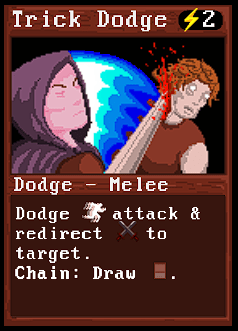
A Rogue card, Trick Dodge has a hilarious and surprisingly deep mechanic where you can completely dodge an attack and smack another enemy with it. I love when classes get unique gameplay mechanics that lean into the particular skills of that archetype.
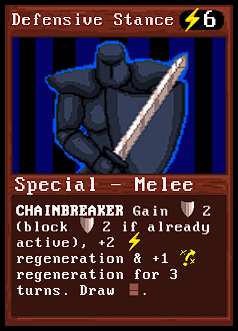
Defensive Stance is a Fighter card, and it’s extremely valuable. Many encounters pit you against several enemies that only do one or two points of damage, so having a 3-turn block for 2 points of damage frees you up to spend your stamina on dodging and attacking. I always try to keep one of these in my hand, even if I already have one active.
Some classes have their own unique resource besides stamina. The Ranger actually expends arrows to attack, which is a nice touch. For 3 arrows and 6 stamina, Arrow Volley is of the best examples of Card Quest’s extremely busy cards. Chain it for further madness.

RDBG #7: Cards of Cthulhu (2016)

Cards of Cthulhu, released on PC on October 11th, 2016, was developed by Brazilian team Awoker Games. A little context I’d like to couch this in before getting into the retrospective proper: its full price on Steam at the time of writing is 0.79 GBP. That’s not even a full US dollar. It’s currently on sale, too, at 71% off. 23 pence sterling, for Pete’s sake. I’m not trying to drum up sales for it – read on and draw your own conclusions. It is, by a considerable margin, the cheapest game we’ve looked at so far, and likely to remain as such for a good while longer. Worth keeping in mind.

Premise and Gameplay

Booting the game will immediately throw you into your first run. You don’t even have to click through a title screen or choose a mode. Assuming you didn’t blink, you may have caught a splash screen of Cthulhu with a woman in one hand and a beer in the other. Presumably, she has been kidnapped and you’re on your way to save her. I’m the sort of person who likes coming up with their own interpretations when things don’t explicitly tell me what’s going on, but Cards of Cthulhu doesn’t really give you even that many pieces to work with in the first place.

I know the whole point of deck-builders is to allow diverse playstyles, but am I the only one who always has to get over an irrational fear of self-damaging moves in almost every new game they play?

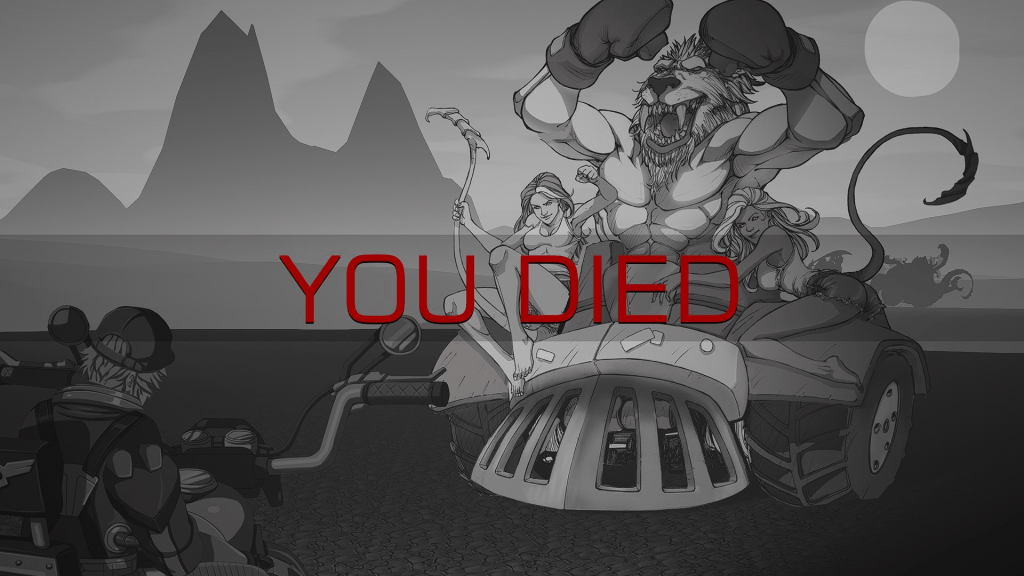
You choose two starting cards and get going on your bike. You add more to the deck over the course of the run, for a maximum of six. The game automatically steers you from enemy to enemy, but you are told in advance what’s coming up next – an encounter, a card drop, or a boss fight. Battles take place in real time, with you and the enemy choosing cards to chip away at one another’s health, cause status effects, and so on. The twist this time around is that the cards alone are not the only way to win. Anytime you’re not waiting for your card to activate or suffering from some sort of status effect cooldown, your motorcyclist will fire away at the enemy with a shotgun, doing a single point of damage every second. The challenge lies not just in knowing what card to play at the right time, but knowing when not to play anything at all. Letting the sawn-off finish the job is sometimes totally fine. Some encounters will pit you against multiple foes one after the other. Because cards can usually only be played once per fight, it’s entirely possible to run out of cards before you’ve beaten all the enemies, so it never becomes a simple game of clicking on cards as soon as they become available.

Blam blam blam, bzzzzz, etc. It’s difficult to express in writing, but every enemy has a pronounced wobble at the joints, like an old action figure on a string being jerked around.

A run plays out over four stages, each consisting of a handful of battles and card drops before a showdown with the great tentacled one. Beating the game unlocks two harder difficulty modes (that can’t be switched between!) and that’s your lot. For every several enemies beaten, you can unlock new cards and passive benefits such as higher maximum health for yourself or lower health for your enemies. I do wonder if it’s possible to even beat the game on your very first run. Some of these unlockable cards are so game-shatteringly overpowered that the mid to late-game enemies seem to come in larger groups or have higher health pools to compensate. You may have a deck of cards you blast through the first two stages with and then run into some real trouble on the third and fourth ones. Even so, with runs taking less than 10 minutes each and every enemy killed contributing to new unlockables, your time rarely feels wasted.

I feel like I’ve seen these words in this fashion somewhere before. Answers on a postcard.

Randomised Elements

The only randomness that really matters are the card drops that are randomly laid out on your path. You can’t do anything to affect the order or types of enemies and bosses that come your way, so all you can do is just choose the best cards from what you’re given. There are about 10 unique enemies you can encounter, and they are even re-used as boss encounters with some minor palette-swapping. One good thing about this is that you can quite quickly get a handle on what certain enemies are likely to do and play around them a little. Guitar-playing, slug-riding demon lady is likely to heal you both to waste your cards, so you may as well not even use any until she does so. Harpy lady with some sort of mechanised hand-bra (lots of women, come to think of it) will wait until she can play a card that does a whopping 8 damage at once, so destroying it before she can trigger it is a good move. For a game you’re likely to beat in an hour or so, this is an acceptable amount of variation, but once you’ve got a handle on what it’s likely to throw at you, there’s little more it can do to surprise you.

Scimitar-cyborg-hoverboard lady? She’ll just kill you.

Presentation

I’ll bring this up first because it’s probably going to be a dealbreaker for a lot of people looking at something with ‘Cthulhu’ in the name – the game isn’t really Lovecraftian in any way. For vibe, it puts me more in mind of the film Heavy Metal, or perhaps a hint of Planet Terror. The background is an unchanging plain that serves purely as a conveyor belt to wheel you to the next encounter. Enemies themselves are a sufficiently demonic bunch. My personal favourite is the chainsaw-wielding fella with several rows of teeth where his abdomen should be. He’s standing at a jaunty angle that makes it seem like he’s having a very hard time balancing his weapon over his head. The body parts of the enemies undulate and swell in a way that is reminiscent of the idiosyncrasies that come with animating multiple layers in Flash. In general, the monsters reminded me of a classmate I had who would use a ballpoint pen to draw similar mutants in his exercise books that would look at home on an old metal album cover. Many players seem to be a bit turned off by the enemies, but I can take or leave them. They’re novel in a kitsch way, but it’s a shame there’s so few of them. You’ll see the same ones repeatedly within the same run. What puts me off more is a lack of aesthetic cohesion. For example, the Cthulhu you see at boot up, the Cthulhu you fight at the end, and the Cthulhu corpse in the ending screen are all drawn by three different artists. In isolation, they all look fine (OK – maybe the boss sprite with a hairy beer gut isn’t to my taste), but are at such stylistic odds with one another that the tone comes undone, assuming one was being set up in the first place.

Uh… it’s good to have permission, I guess?

Besides an ending song, there is no music at all, just an ominous background hum, which is fairly fitting. The trailer on the Steam page has a reasonably exciting piece of BGM that doesn’t appear anywhere in-game, but I imagine if that was the only song around, it would get repetitive very quickly. The sound effects are serviceable. They exist. The gun sounds like a gun. The motorbike sounds like a bike. Moving on. I am grateful that you can mouse over your cards for tooltips on how they work, but you will have so few in your deck at any one time you will rarely need a reminder of their functions. All in all, very little about the presentation is going to stick with you after you stop playing. For an indie title, these things matter considerably to its legacy. In the previous post, we saw Frost get its world of chilly desperation just right. For that, I’m inclined to think about it from time to time. I’m not sure yet what I’ll remember about Cards of Cthulhu in a few weeks, months, or years from now.

Closing Remarks

Given the price, I went into Cards of Cthulhu with very low expectations and as such didn’t come out at all disappointed. The deck size and number of decisions you can make at any given time are quite low, and it is orders of magnitude less complex and involving than, say, Coin Crypt, with which it shares its snap-decision combat. While there isn’t anything to come back to besides higher difficulties that get progressively easier with unlockables, I can’t say I didn’t enjoy the 3 or so hours I spent with it. It certainly wasn’t a waste of money, at least. Do you know what else you can buy for 79p nowadays? Nothing.

Standout Cards

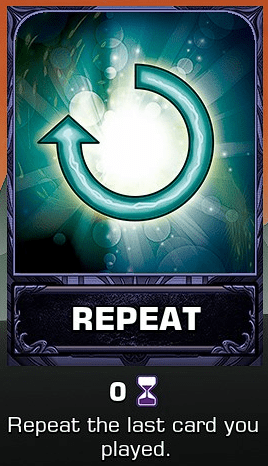
Repeat is straight busted. Poison something twice and immediately. Freeze something twice and immediately. Invaluable. Almost never a reason not to pick it up.
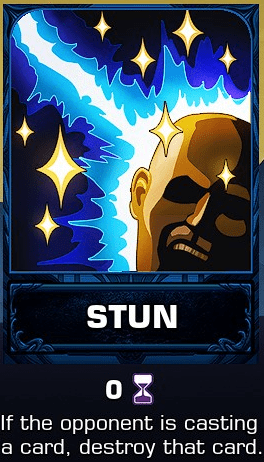
Your deck is very limited in size, but so is your opponent’s. Stun is good because destroying a card not only stops you from getting hit by something nasty, but can also potentially reduce the enemy to just swatting at you for chip damage when they run out of things to play.
Cards are usually single-use per battle, so running out of things to play is a real concern. Mind Steal not only keeps you topped up, but also lets you know exactly what the other side has up their sleeve.