

Release: September 15th, 2021
Developers: uvula, Matthew Grimm, Shaun Inman
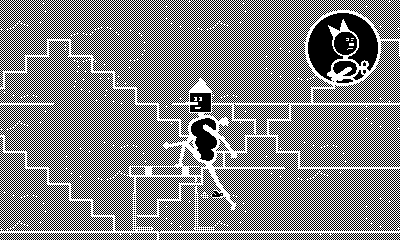
Building block-based narcoleptic Crankin needs your help to arrive late to dates with his extremely tolerant girlfriend. The crank is the only way to interact with the game. Turning it clockwise moves Crankin forward in a manner akin to playing a music box. Turning it counterclockwise ‘reverses’ him. Pacing is key: Crankin’s girlfriend won’t hang around forever, so you will have to be cautious about when you choose to speed up, slow down, or turn back. Between Crankin and the earful he deserves are numerous enemies that cannot be directly defeated, only avoided. The biggest name behind Crankin is Keita Takahashi of Katamari Damacy fame, and it was screenshots and footage of this game that was doing a lot of the heavy lifting for the Playdate when it was being demonstrated pre-release.
Crankin calls its levels ‘dates’, and I greatly enjoyed the first ten or so. The novelty of the sound effects and stage elements speeding up and slowing down in real time with how quickly you spin the crank never really gets totally old. Unfortunately, the game goes on for fifty levels. The wheels fell off for me in this order. First, the limited view of what’s in front of Crankin’s (very large) figure makes it difficult to see enemies until they’re already on-screen and almost undodgeable, reducing most levels to a repetitive challenge of trial and error. This is a problem people had solved as far back as the first Game Boy with Super Mario Land in 1989, if not earlier: keep your sprites and level elements at a small scale for small displays. Crankin can’t take a single hit from anything, and stepping on dog crap will kill him as handily as getting trampled by a stampeding pack of pigs, so back to the start of the level you go. Second, you realise this is the whole game. I wondered why the official Playdate website categorises this as a ‘Racing’ game, but as I played more I gradually realised that’s a fitting tag. It has a Trackmania or Gran Turismo-esque time attack feel to it, where the only way to get to the end faster is to memorise the order of obstacles over and over again until you do it perfectly. The final nail came when my sense of pride in beating a level immediately evaporated because my reward was always just another, usually even harder, level. I call this the ‘screw you’ gameplay loop. The novelty of new level elements immediately wears off because you’re only beating levels out of spite. I tapped out on Crankin around the 25th date. I’ve stopped talking to more than one person in real life because they weren’t able to stick to appointments way fewer than 25 times, and I’d advise Crankin’s girlfriend to do the same.
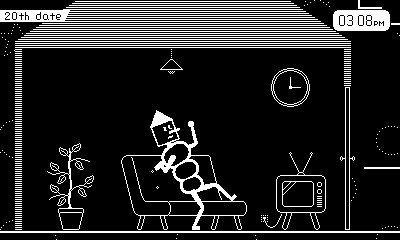
Let’s finish with the good, because I found a lot here before it started to grate with me. The visuals take full advantage of it being a Playdate game: completely black, with characters and obstacles being etched with white outlines of varying thicknesses. I’m not sure if I can call something that doesn’t use colour ‘vibrant’, but for a game as full of negative space as this, it certainly achieves a lively whimsy that exceeds what you may expect from the device. In a touch I’ve never seen another game do on hardware orders of magnitude more powerful than the Playdate, the game’s animated home menu icon (an adorable Crankin asleep on his sofa, as he is at the start of every level) seamlessly transitions into the game itself once booted. That’s absolute magic. As with Casual Birder, the Playdate’s powerful sound capabilities are proving to be one of the system’s secret weapons: Crankin has some great SFX, and hearing them get stretched out or reversed in time with the crank manipulation brings back memories of playing records at speeds you shouldn’t. Ultimately, this one had the steepest novelty-to-irritant drop-off of any Playdate game I’ve tried yet, but its commitment to doing things that only this system can do is still to be admired.

 Shrunken Shrine