RDBG #2: Dream Quest (2014)

UPDATE (Jul 25th, 2024): In celebration of the game’s 10th anniversary, I interviewed the game’s developer, Peter Whalen, which you can click here to watch or see at the bottom of this post.

Our first game to explicitly use actual cards in its deck-building is Dream Quest, a largely one-man project by Peter Whalen originally released as a mobile game on iOS in 2014. Today we’re looking at its PC port, released on May 14th, 2014, according to Steam (I have no date for the iOS release). Having to click an X to close boxes and not being able to use arrow keys for movement betray its touchscreen origins, but it’s playable enough with a mouse. Having the UI elements spread out over a high resolution display partly makes up for the slightly rough edges retained in the transition from mobile.

Premise and Gameplay

Players must descend through three levels of grid-based dungeons, encountering enemies, shopping at stores that provide cards or alter your deck, and other such interactions. If you’ve played Slay the Spire – an assumption I feel fairly safe in making if you’re reading these posts – you may be very surprised just how similar it is. There’s not a lot going on plotwise, other than an amusing little bit of between-floor flavour text that randomises some of its adjectives and nouns every run.

Actually, these provide some hints about what the floor boss is – so not that random!

Engage an enemy in combat and you will take turns drawing and playing cards collected throughout the dungeon until one of you dies. There’s several things to keep track of, but it isn’t overwhelming. Are you playing enough mana to be able to use powerful spells? Are you focusing on passive abilities granted by equippables, or do you prefer card effects themselves? Are you building your deck around blocking and healing damage, or are you trying to raise your chances of dodging it outright? 

Your run begins with you choosing one of four starting classes (but there’s many more to unlock): Priest, Wizard, Thief, and Warrior, each with their own unique gameplay twists. Priests and Wizards are fragile but are able to use powerful mana-limited healing or attacking spells, while Thieves and Warriors focus more on the quantity or power of their attacking cards. Further to this are class-specific talents which, once used, need to be recharged after a number of encounters. Warriors can ‘smash’ one tile of dungeon walls to potentially open new paths, while Priests can illuminate dangers and treasures anywhere in the dungeon. With over 300 unique cards, there is a lot of scope for different builds with different classes. The catch is that the learning curve for a sense of what those builds may actually be is steep and can take several runs. If the gameplay gets its hooks into you, then that’s no problem, but without a tutorial or suggestions for what directions to take certain characters in, unpeeling the onion with trial and error will either engage or frustrate you. Regardless of what strategy or class you go with, I found it best to try to choose it early and stick with it. Bosses and elites are punishing and have passive abilities that can come down hard on an unprepared deck. I must give credit that many enemies have elemental resistances, an added consideration when collecting cards and something I’ve yet to see in any other roguelike deck-builder. With card draw and hand size being so limited early on, it is better to have a deck that does one or two things well rather than just picking up every powerful card that comes your way.

Randomised Elements

Randomised elements include the positions of enemies, card drops, and the layouts of each dungeon floor, which is obscured in a ‘fog of war’ that hides potentially dangerous encounters. Your character’s name is also randomised each time, which is amusing.
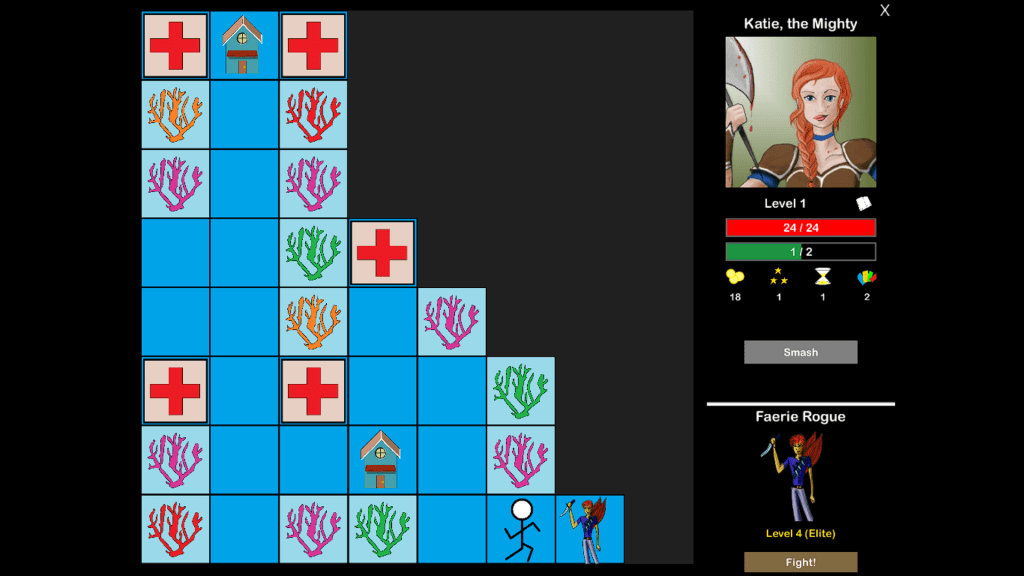
The whole thing has a very homebrew feel to it, but with gameplay depth that would humble a lot of current-gen triple-A stuff.

At times, it’s a game where you definitely feel the forces of luck, but I found it to giveth and taketh in fairly equal measure. My more fruitful runs were usually those wherein the first or second floors had more than one healing monastery or upgrade spot. Your first heal or upgrade is free, but subsequent patronage costs gold. However, if there are multiples of the same kind of location on the same floor, you can bounce between both and save money. Likewise, some runs will grant you a powerful card or two early on that you can really anchor the rest of your deck around. When playing as the Warrior, I will generally look for something that will increase deck draw – you can play as many action cards as you like without resource restrictions, and there’s something really enjoyable about cards doing additional damage because you’ve just played so damn many of them.

On the other hand, several runs ended before having a realistic shot of getting off the ground due to having no real direction in the deck, or getting stuck fighting an enemy that you’re just plain underleveled for or have nothing in your deck to target their weaknesses with. The bosses do not mess around and there will be times you get forced into a fight you feel a good level or two away from standing a good shot of winning. The wizard has the ability to teleport around the map, but doing so risks putting him in areas he can’t escape unless through opponents that significantly outlevel him. Generally however, enemy encounters feel well designed, and the game gives you plenty of those exciting sat-upright ‘how-am-I-gonna-get-outta-this’ moments when something shows up with a surprising attack or passive ability. Even your worst run will have you feeling like it was partly your own fault for not having made better decisions, and you do take away spendable points, so your time is rarely wasted. In fact, you can even use a ton of these points to restart your run from the start of the floor you died on, so even when your run ends, there’s still interesting decision-making to be had. 
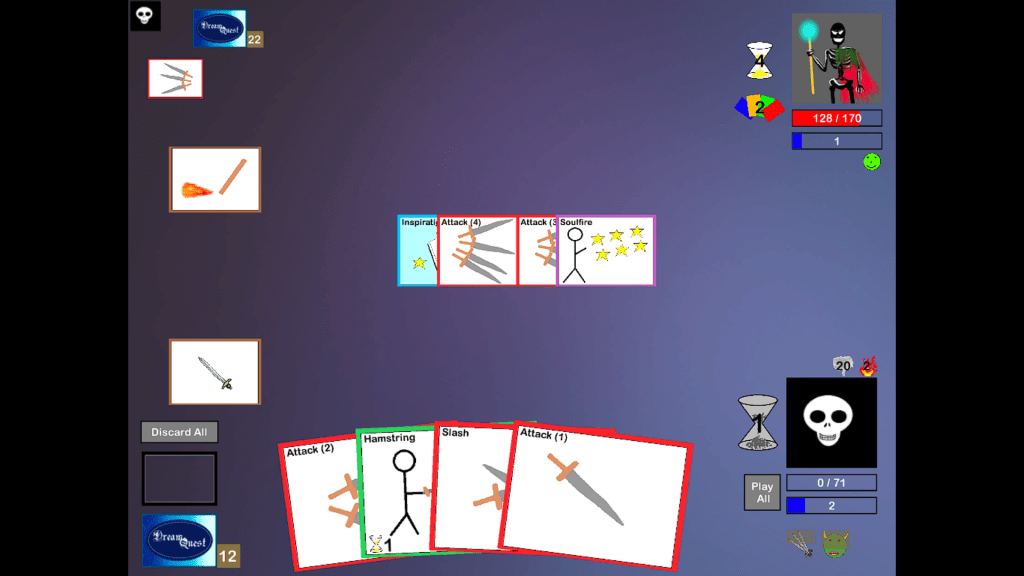
Death comes for us all, just for me more often than most.

Presentation

Unfortunately, no mention of Dream Quest can get around the topic of its artwork. I don’t want to harp on about it, but I think it’s safe to say it is probably the deciding factor that truly held back its chances to be a breakout indie hit before Slay the Spire came along. Even in 2014, indie games lived or died by their ability to get a viral foot in the door. The sketch-like character portraits (suggested by online commenters to have been done by Peter Whalen’s daughter; I could not find a source for this) and stickman card art (by Whalen himself) essentially guaranteed the game would not be looked at twice by many. 
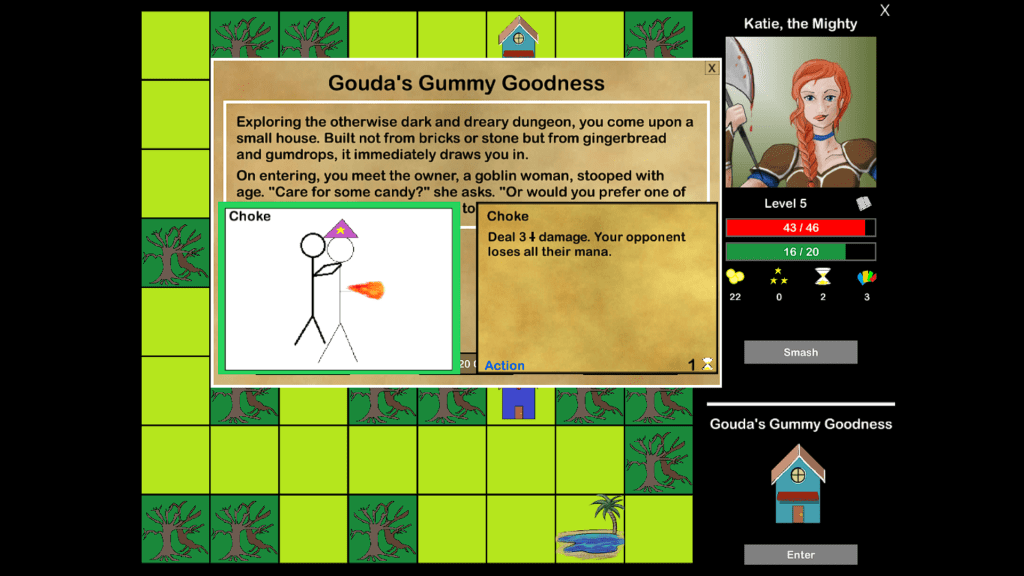
More’s the pity, really, because several of them, like Choke here, are very funny.

A lesser whinged-about element of its presentation, funnily, is the music. The limited selection of tracks here are either merely suitable at best or curiously inappropriate (the ‘cloud’ area music comes to mind). Anyone who watches too much YouTube may recognise one or two of Kevin MacLeod’s royalty-free bangers putting in some work. There are no sound effects at all, save for a rather satisfying level-up fanfare. You will be wanting your own background noise after the first few hours, really. Nevertheless, let your eyes get used to your first run or three, and you will soon stop caring about the cosmetics. Indeed, the MS Paint-esque card art actually has a minimalist purity to it – the majority are basic stickmen or weapons that convey what they are at a glance. 

Closing Remarks

Go into Dream Quest with reasonably adjusted expectations and I think you may be surprised how fully-featured it is. By this, I mean that in spite of its appearances, it already features a surprising number of the gameplay elements that we take for granted in more modern examples from the genre. Most nouns and verbs that have particular terminology definitions have clickable tooltips explaining what they mean. Passive abilities and new cards are unlocked upon losing a run (play on harder difficulties to speed this up). ‘Elite’ enemies and optional events are hidden around the maps; a risk-reward staple of the genre. Dream Quest lacks the presentational or mechanical onboarding it needed to get curious people or genre newcomers through the door in its own time, but to see so many of the staple elements of the genre present and accounted for at such an early stage makes it no harder to enjoy now than it was then. It’s no less rich an experience than playing Slay the Spire with beta art.

Standout Cards
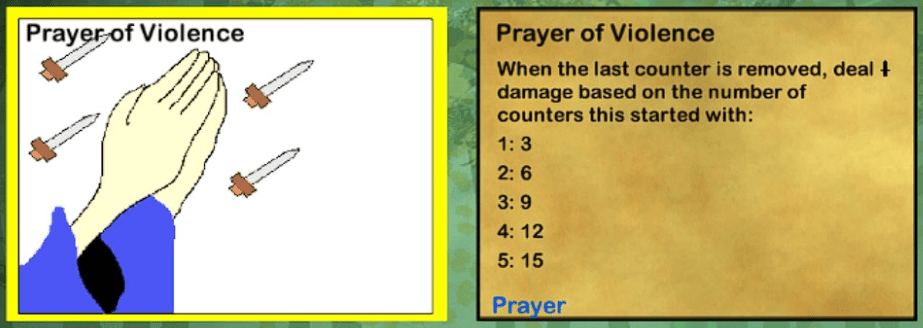
The Priest can play Prayer cards, which let you choose how many turns later you want its effect to kick in, becoming more powerful the longer you wait. It’s quite a unique gameplay mechanic, and you can build viable decks around several of these with other cards that trigger them early. 

There’s a lot of cards in the game that focus on card draw, but Rallying Stroke’s 2-cards-2-damage always make it a welcome sight. Attack cards don’t cost any resource to play, and whittling an enemy down by drawing and playing card after card is great fun.

I mean, look at it. It’s Wrath of God. You may not like this art, but there is a certain humour in its simplicity. These stickmen go through some pretty awful stuff!
Dream Quest 10th Anniversary Developer Interview with Peter Whalen

RDBG #1: Coin Crypt (2013)

UPDATE (Nov 18th, 2023): In celebration of the game’s 10th anniversary, I interviewed the game’s developer, Greg Lobanov, which you can click here to watch or see at the bottom of this post.

There isn’t a ton of material out there making claims as to what the ‘first’ roguelike deck-builder may be. This Verge article points to Peter Whalen’s 2014 mobile game Dream Quest (as “the “watershed” moment for the modern iteration of the genre”. Likewise, Joshua Byer’s Game Design Deep Dives: Roguelikes submits that “Dream Quest is viewed by many as the progenitor for deck-building roguelikes.” As an original game that explicitly combines card deck-building with randomised adventure elements, it seems fairly sound to call Dream Quest the first of its kind. We’ll be looking at it in the next post. However, it isn’t isn’t quite the oldest game that meets my criteria

According to data trawlers SteamDB and Steamspy, the earliest released game with the tag ‘Roguelike Deckbuilder’ is a game called Coin Crypt, developed by Greg Lobanov and released through Steam Early Access on November 18th, 2013. There may yet be something before this that meets my rules and either didn’t receive a Steam release or slipped through the cracks of my search engine hunt. Nevertheless, I feel fairly confident in taking Coin Crypt as a starting point and will happily entertain debate on alternatives. (Not to get into the weeds here, but sometimes I wonder how many hobbyist prototypes, unfinished demos, or notebook ideas of things we would now recognise as a roguelike deck-builder may be out there that predate Coin Crypt.)

Premise and Gameplay

Somewhere in the Pacific, the lost ruins of a ‘coin civilisation’ have been uncovered, luring ‘lootmancers’ to do battle in a bid for the ultimate treasures at their highest peaks and deepest depths. The Rogue influence is readily apparent in Coin Crypt’s overworld. In a single run, players traverse several worlds divided into three randomised stages occupied by enemies, shopkeepers, and hidden secrets. Coins are required to do almost anything – they function as your battle actions, currency, and health. Using up all your coins is a lose condition akin to ‘decking out’ in a physical CCG, immediately ending the run. Funnily enough, you can also defeat enemies like this, although doing so means you won’t win those coins as loot. Coins aren’t just single-use in battle, they’re single-use for good – so keeping your deck (purse?) topped-up while being careful not to fill it with turn-wasters is paramount.

You can see what enemy attacks are incoming, but if you’re able to regularly do that while choosing your best coin, you may have two brains or at least four eyes.

The one-on-one battles play out similarly to Active Time Battles in the Final Fantasy series – turn-based, but with factors affecting how quickly and often those turns come about for both sides. Once selected, some coins take longer for their effect to trigger than others. You can only draw a few coins from your ‘deck’ into your hand each round, and you must work out which one to play ASAP. Fast choices minimise damage and maximise loot from foes. Multiple coins can be played simultaneously if you draw more than one of the same kind, and you can forfeit a turn for a redraw if you’d rather save certain drawn coins for another time. This may sound like an awful lot to be keeping track of, but it makes for very short, addictive battles that demand good, quick decision-making that anticipates future moves or even battles.

Failed runs reward players by allowing them to redeem the total value of coins gained during their run for new character classes, and there’s a lot of them: 20 classes to the base game and 7 in the one DLC package, Sea and Sky, which also adds new overworld areas and rewards. Granted, their individual differences do not always completely transform playstyles in the way the four Slay the Spire classes are so different from one another, and the game’s difficulty is radically altered by who you pick. Still, there’s a lot of novelty and challenge to be had – I find myself drawn to the Assassin, who hits hard but can’t heal well, and the Wizard, who regains multiple copies of coins used in battle but also simultaneously loses ones at random from their deck.

New classes and coins are unlocked thick and fast, even for this genre.

An admission – I love this genre, but I’m not very good at it! It took me 10 hours to even beat the game once, and even then with a non-standard class (the Wizard) using an alternative coin bag (one that makes you likelier to pick up damage-dealing coins). In that time I unlocked every character class you can with coins from failed runs. Nevertheless, I feel it fair to say that the game is a little cryptic (ha!) about some of its mechanics. For one, you can offer coins to deities, who in return will grant you certain coins or debuff enemies. I completely ignored them for my first several runs because I was more concerned about loss by deck-out, unaware that they were buffing later enemies in anger for my lack of piety.  Shop items often seem very expensive given that coins are also your literal lifeblood. Lastly, the ‘blessing’ system, which gives you a selection of buffs that always come with a debuff, almost always felt too punitive to risk using. Which of these are balancing or difficulty curve failings and which of these are just my own ineptitude will vary by the player, of course. Whether these mechanics enrich or frustrate is one thing, but they will be a part of the decision-making in every run, so they bear mentioning.

Randomised Elements

Besides enemy and loot chest placement, the levels of Coin Crypt are made up of randomly put-together hallways and rooms. Players have some decent agency in their exploration. If you want to make a mad dash for each level’s exit, losing as few coins on the way as possible, you can do that. If you feel like your coin build benefits from fighting everything you come across, you can do that, too. If you’re able to unlock certain barriers, you can even take alternate paths to plumb the ruins’ depths rather than scale their heights, leading to different enemies, coins, bosses and so forth. On the other hand, the randomisation sometimes led to my runs ending long before they ever even got off the ground, and when a run started going south, I rarely felt able to delay failure for much longer. I’m not sure if this is an overdependence on random number generation to draw good coins or if certain classes just have a harder time building up steam than others, but it was rarely so discouraging a loss that I didn’t want to jump right back in.

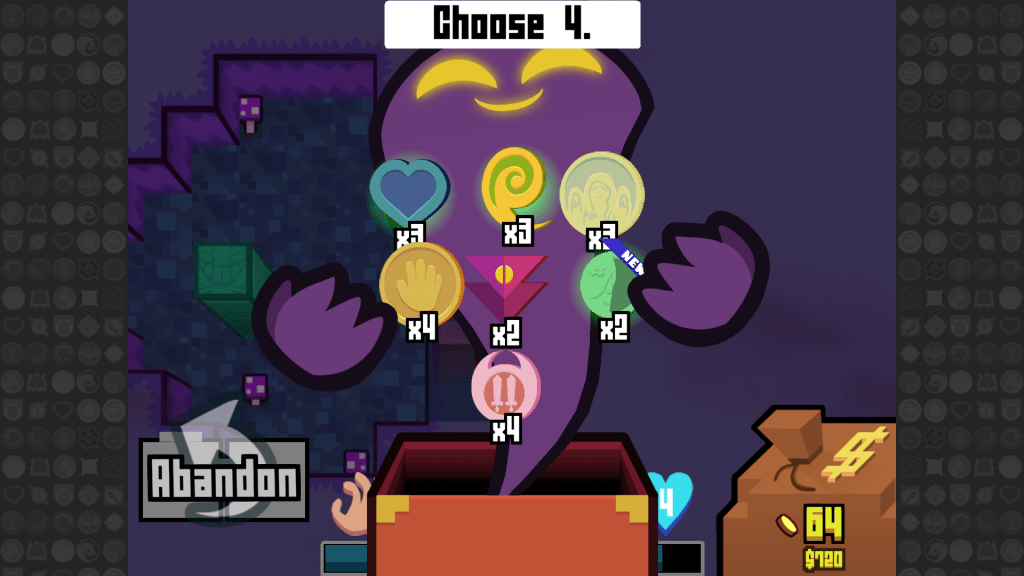
Donating to deities will make certain coins more or less common as loot from these chest ghosts.

Presentation

So yes, some minor issues, but the compulsion inherent to the gameplay loop is very powerful and is reflected in the sound and visuals. There’s a palpably sweet tension in choosing a coin and hoping it pops off before the enemy’s, and the accompanying sound effects of a bunch of loot being dropped into your bag upon victory (essentially extending a time limit on your survival) brings relief. Seeing the little ‘NEW!’ tag next to a shiny coin you haven’t seen before satisfies the primate brain, as is then immediately weighing up whether or not it plays nicely with everything else you’re currently rolling with.

The colours and UI elements are bold and bright. In a world of mostly cuboid elements, the coins are a real standout – there is intrinsic satisfaction in seeing the not-actually-3D coins in your deck spinning around. The hard edges and flat colours can lose their flavour after a while, but the hand-drawn character and enemy art gives the game’s visual elements a certain unity and timelessness. Also, being able to directly WASD-key your character around RPG-style rather than simply clicking on waypoints between scenarios is very involving, especially if you really can’t afford to get into a fight when you’re bleeding coins.

An aside on the coin design. Unlike most games in this genre, taking your time with your movemaking is actively discouraged, so being able to identify what each coin does the instant it gets drawn is very important. Coin Crypt’s solution is to have the shapes, iconography and colours of the coins broadly reflect what they do. Damage-dealing coins, for example, will generally either be red in colour, have spiked edges, or feature a sword icon. Healing coins are typically blue or feature cross-shaped edges or icons. More exotic damage or healing coins may only feature one or two of these elements, but as long as you recognise one of them immediately it should give your brain the quick hint it needs to recall what it does. With 201 coins to the base game and another 100 in the DLC, they don’t all perfectly follow an internal consistency (as attested to by this ‘coin encyclopaedia’) but I rarely found myself totally stumped by what a coin did upon drawing it. Unfortunately, in the instances I did forget what a coin did in battle, I found that the reminder tooltips could sometimes get obscured by other rapidly-changing UI elements when you hover over them – not ideal in the middle of a frantic battle that could be your last. Regardless, the point I’m striving for here is that many roguelike deck-builders can consider the art that comes with their cards to be a luxury or visual afterthought to their gameplay utility. For Coin Crypt, the coin design is integral to its playability.

Closing Remarks

These retrospectives are not intended to be reviews, but I would like to encourage people to try out the ones I enjoy as I go along. Coin Crypt‘s sheer combat speed alone makes it worth seeing if it’s something you like. The compulsion to always be casting coins removes the indecision paralysis that sometimes puts people off card games. While its systems and synergies are a bit opaque for your first several runs, you will eventually find a handful of classes or strategies you enjoy that bring you closer to endgame runs if you stick with it. (Also, I’m stunned it isn’t available on mobiles – the large coins and mouse-click-navigable environments at times make it feel like it was designed from the ground-up for such a thing!)

Standout Cards

An ongoing closing feature I’ll include here will be cards (or in this case, coins) that have stuck with me for whatever reason during my time with the game. These aren’t my suggestions for the best cards, simply ones that may have served me well, are cosmetically interesting, or have some other noteworthy quality.

Healing and damage dealing at the same time makes the Bat Pence an extremely valuable spammable on any run with a class that lets you keep or duplicate coins.
A little two-for-one to display the coin design at its most intuitive (and cute). The two sharp points or cross arms denote its minimum value, while the coin’s six main edges represent its maximum. The colors and shapes suggest damage dealing and healing respectively. Again, not all coins in the game are this effortless to ‘read’, but when they are, it impresses.
Poor Jack’s 10-to-hit, 2-to-cast costing make it a standout example of the risk-reward deckbuilding. The temptation to have as little in your deck as possible except these can easily lead to doom when you skimp on shielding and healing coins to keep them strong.
Coin Crypt 10th Anniversary Developer Interview with Greg Lobanov

Roguelike Deck-building Games – A Chronological Exploration

I enjoy retrospectives that go through a topic in chronological order, especially for video games, a medium that is nothing if not iterative. I thought I’d start off using this space to examine the young but increasingly popular roguelike deck-building subgenre, in release order (or as close as is possible to determine). 

A hasty author’s rendering of some familiar roguelike deck-building game elements using the player’s avatar of Rogue (1985), including a deck, a hand of actions, and an enemy of some sort.


To start, some criteria a game should meet to be up for consideration here: 

  1. ‘Roguelike’: The game must prominently feature randomisation in how it offers exploration, skills, combat, and so on – with the intent of encouraging multiple runs and alternative playstyles.
  2. ‘Deck-building’: The game doesn’t necessarily have to feature cards per se, but the gameplay must prominently feature a mechanic similar to managing a loadout of cards in a collectible card game. For example, you should be able to gain and lose skills as gameplay progresses; there should be limitations on how these skills are gained, deployed, etc.
  3. ‘(Video) Game’: The game must be an original video game, rather than a digital adaptation of an existing physical card or board game.

Going by these, I’m going to start with 2013’s Coin Crypt. 2013 may seem surprisingly recent, but to my knowledge Coin Crypt is the first game that meets my criteria (please get in touch if you think differently). Remove the roguelike requirement, and we would have a few original deck-builder video games from the late 1990s, such as Chron X and Sanctum. Even with the requirement for it to be an ‘original’ video game, anything I will cover here will carry some influence from Magic: The Gathering or one of its mid-late ‘90s collectible card-game progeny, such as Netrunner or the Pokemon Trading Card Game. Perhaps the key inspiration for roguelike deck-building gameplay would be the 2008 board game Dominion. While the resource management can be traced to Magic’s mana system, Dominion has players build decks from cards semi-randomly collected as play progresses. As such, the key distinction for the roguelike deck-builder is in players finding emergent deck possibilities in cards that work well together as they collect and use them, rather than having time to plan a synergistic deck before battle begins.

Ultimately, the rabbit hole on projects like this can be made ever wider, but for the sake of relevance and manageability I’m casting a fairly narrow net. Even if we went all the way back to the genre namesake of Rogue (1985), that in itself was inspired by other mainframe computer takes on Dungeons & Dragons, which in turn was inspired by tabletop wargaming, which in turn was… it can’t be ruled out that all human culture probably stems from enjoyment found in swinging sticks at one another, or somesuch.


To conclude this introductory post: rather than an attempt to divine the exact genesis of the roguelike deck-builder, the aim here is to chronicle points of interest, similarity, difference, and evolution in a subgenre that saw an explosion of popularity with the early-access release of Slay the Spire in 2017 and continues to see a fascinating degree of variation in the wake of its success, even within my fairly fixed gameplay criteria. First game to follow.