RDBG #7: Cards of Cthulhu (2016)

Cards of Cthulhu, released on PC on October 11th, 2016, was developed by Brazilian team Awoker Games. A little context I’d like to couch this in before getting into the retrospective proper: its full price on Steam at the time of writing is 0.79 GBP. That’s not even a full US dollar. It’s currently on sale, too, at 71% off. 23 pence sterling, for Pete’s sake. I’m not trying to drum up sales for it – read on and draw your own conclusions. It is, by a considerable margin, the cheapest game we’ve looked at so far, and likely to remain as such for a good while longer. Worth keeping in mind.

Premise and Gameplay

Booting the game will immediately throw you into your first run. You don’t even have to click through a title screen or choose a mode. Assuming you didn’t blink, you may have caught a splash screen of Cthulhu with a woman in one hand and a beer in the other. Presumably, she has been kidnapped and you’re on your way to save her. I’m the sort of person who likes coming up with their own interpretations when things don’t explicitly tell me what’s going on, but Cards of Cthulhu doesn’t really give you even that many pieces to work with in the first place.

I know the whole point of deck-builders is to allow diverse playstyles, but am I the only one who always has to get over an irrational fear of self-damaging moves in almost every new game they play?

You choose two starting cards and get going on your bike. You add more to the deck over the course of the run, for a maximum of six. The game automatically steers you from enemy to enemy, but you are told in advance what’s coming up next – an encounter, a card drop, or a boss fight. Battles take place in real time, with you and the enemy choosing cards to chip away at one another’s health, cause status effects, and so on. The twist this time around is that the cards alone are not the only way to win. Anytime you’re not waiting for your card to activate or suffering from some sort of status effect cooldown, your motorcyclist will fire away at the enemy with a shotgun, doing a single point of damage every second. The challenge lies not just in knowing what card to play at the right time, but knowing when not to play anything at all. Letting the sawn-off finish the job is sometimes totally fine. Some encounters will pit you against multiple foes one after the other. Because cards can usually only be played once per fight, it’s entirely possible to run out of cards before you’ve beaten all the enemies, so it never becomes a simple game of clicking on cards as soon as they become available.

Blam blam blam, bzzzzz, etc. It’s difficult to express in writing, but every enemy has a pronounced wobble at the joints, like an old action figure on a string being jerked around.

A run plays out over four stages, each consisting of a handful of battles and card drops before a showdown with the great tentacled one. Beating the game unlocks two harder difficulty modes (that can’t be switched between!) and that’s your lot. For every several enemies beaten, you can unlock new cards and passive benefits such as higher maximum health for yourself or lower health for your enemies. I do wonder if it’s possible to even beat the game on your very first run. Some of these unlockable cards are so game-shatteringly overpowered that the mid to late-game enemies seem to come in larger groups or have higher health pools to compensate. You may have a deck of cards you blast through the first two stages with and then run into some real trouble on the third and fourth ones. Even so, with runs taking less than 10 minutes each and every enemy killed contributing to new unlockables, your time rarely feels wasted.
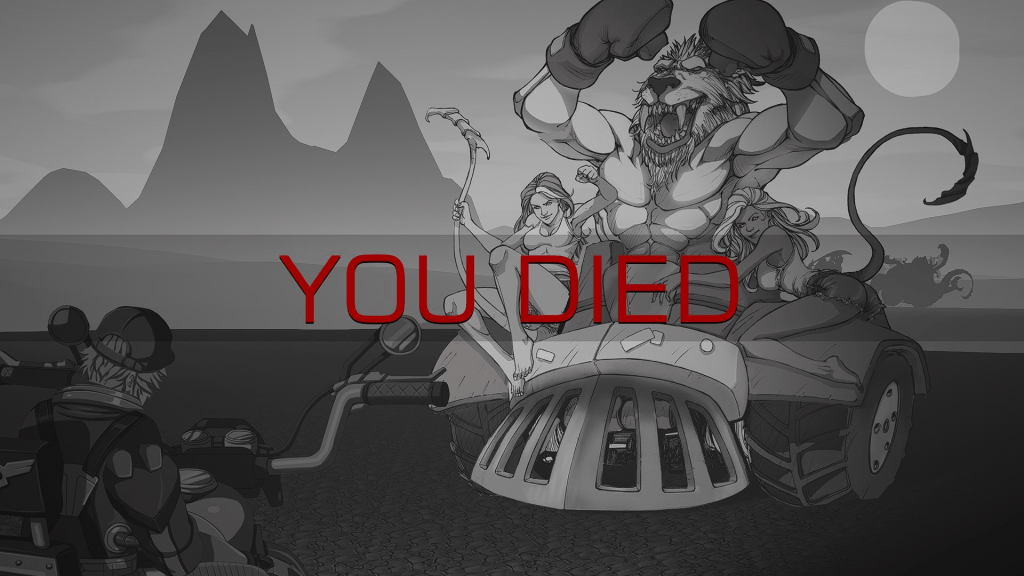
I feel like I’ve seen these words in this fashion somewhere before. Answers on a postcard.

Randomised Elements

The only randomness that really matters are the card drops that are randomly laid out on your path. You can’t do anything to affect the order or types of enemies and bosses that come your way, so all you can do is just choose the best cards from what you’re given. There are about 10 unique enemies you can encounter, and they are even re-used as boss encounters with some minor palette-swapping. One good thing about this is that you can quite quickly get a handle on what certain enemies are likely to do and play around them a little. Guitar-playing, slug-riding demon lady is likely to heal you both to waste your cards, so you may as well not even use any until she does so. Harpy lady with some sort of mechanised hand-bra (lots of women, come to think of it) will wait until she can play a card that does a whopping 8 damage at once, so destroying it before she can trigger it is a good move. For a game you’re likely to beat in an hour or so, this is an acceptable amount of variation, but once you’ve got a handle on what it’s likely to throw at you, there’s little more it can do to surprise you.

Scimitar-cyborg-hoverboard lady? She’ll just kill you.

Presentation

I’ll bring this up first because it’s probably going to be a dealbreaker for a lot of people looking at something with ‘Cthulhu’ in the name – the game isn’t really Lovecraftian in any way. For vibe, it puts me more in mind of the film Heavy Metal, or perhaps a hint of Planet Terror. The background is an unchanging plain that serves purely as a conveyor belt to wheel you to the next encounter. Enemies themselves are a sufficiently demonic bunch. My personal favourite is the chainsaw-wielding fella with several rows of teeth where his abdomen should be. He’s standing at a jaunty angle that makes it seem like he’s having a very hard time balancing his weapon over his head. The body parts of the enemies undulate and swell in a way that is reminiscent of the idiosyncrasies that come with animating multiple layers in Flash. In general, the monsters reminded me of a classmate I had who would use a ballpoint pen to draw similar mutants in his exercise books that would look at home on an old metal album cover. Many players seem to be a bit turned off by the enemies, but I can take or leave them. They’re novel in a kitsch way, but it’s a shame there’s so few of them. You’ll see the same ones repeatedly within the same run. What puts me off more is a lack of aesthetic cohesion. For example, the Cthulhu you see at boot up, the Cthulhu you fight at the end, and the Cthulhu corpse in the ending screen are all drawn by three different artists. In isolation, they all look fine (OK – maybe the boss sprite with a hairy beer gut isn’t to my taste), but are at such stylistic odds with one another that the tone comes undone, assuming one was being set up in the first place.

Uh… it’s good to have permission, I guess?

Besides an ending song, there is no music at all, just an ominous background hum, which is fairly fitting. The trailer on the Steam page has a reasonably exciting piece of BGM that doesn’t appear anywhere in-game, but I imagine if that was the only song around, it would get repetitive very quickly. The sound effects are serviceable. They exist. The gun sounds like a gun. The motorbike sounds like a bike. Moving on. I am grateful that you can mouse over your cards for tooltips on how they work, but you will have so few in your deck at any one time you will rarely need a reminder of their functions. All in all, very little about the presentation is going to stick with you after you stop playing. For an indie title, these things matter considerably to its legacy. In the previous post, we saw Frost get its world of chilly desperation just right. For that, I’m inclined to think about it from time to time. I’m not sure yet what I’ll remember about Cards of Cthulhu in a few weeks, months, or years from now.

Closing Remarks

Given the price, I went into Cards of Cthulhu with very low expectations and as such didn’t come out at all disappointed. The deck size and number of decisions you can make at any given time are quite low, and it is orders of magnitude less complex and involving than, say, Coin Crypt, with which it shares its snap-decision combat. While there isn’t anything to come back to besides higher difficulties that get progressively easier with unlockables, I can’t say I didn’t enjoy the 3 or so hours I spent with it. It certainly wasn’t a waste of money, at least. Do you know what else you can buy for 79p nowadays? Nothing.

Standout Cards
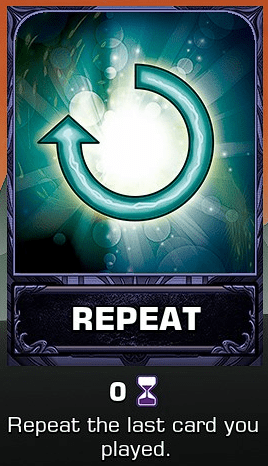
Repeat is straight busted. Poison something twice and immediately. Freeze something twice and immediately. Invaluable. Almost never a reason not to pick it up.
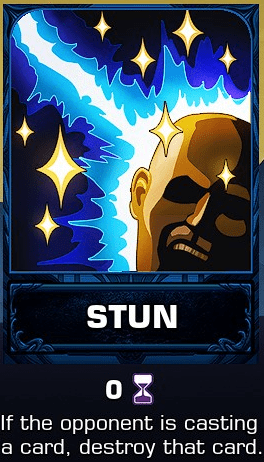
Your deck is very limited in size, but so is your opponent’s. Stun is good because destroying a card not only stops you from getting hit by something nasty, but can also potentially reduce the enemy to just swatting at you for chip damage when they run out of things to play.
Cards are usually single-use per battle, so running out of things to play is a real concern. Mind Steal not only keeps you topped up, but also lets you know exactly what the other side has up their sleeve.

RDBG #6: Frost (2016)

From here on out, we’re going to see the pace of game releases pick up speed. Slay the Spire is just over a year out from early access at this point, and there’s already something in the water among western devs taking inspiration from card game classics. Frost, released for PC on July 5th, 2016, comes to us by way of French developer Jérôme Bodin’s studio Le Studio des Ténèbres, and wears its influences on its Steam page: “Dominion, Ascension, etc”. Its narrative hook is tied very heavily to its gameplay systems, something quite special this early on among the games we’ve seen.

Premise and Gameplay

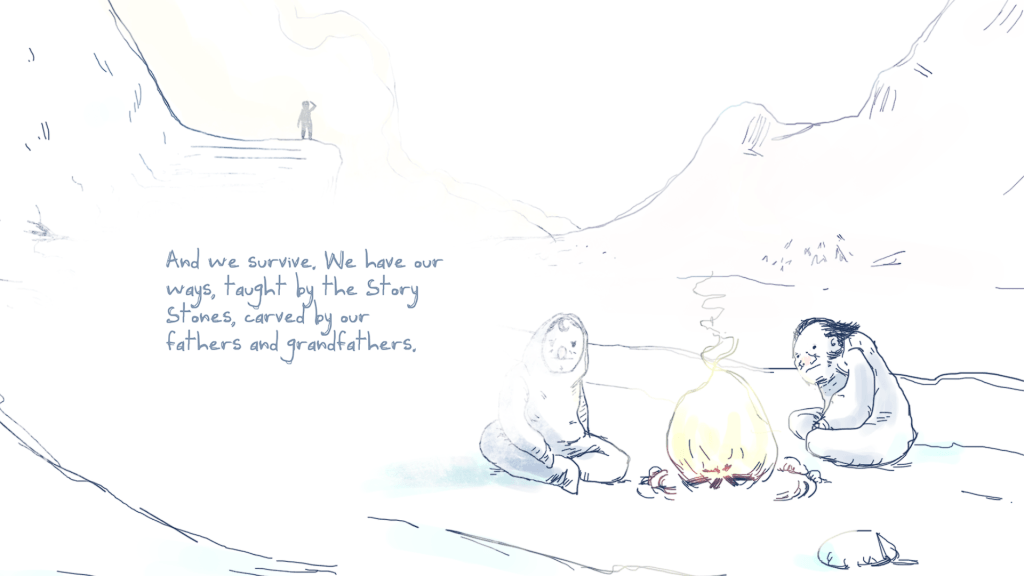
A deadly storm that reduces all in its wake to dust torments a band of wanderers who seek the ‘Refuge’, a place of safety where the storm, which they call the ‘Frost’, will not be able to reach them. It’s that simple. It works, too. We know next to nothing about our characters except their suffering. You can read as much or as little into it as you wish. 

A small touch I like: moving your mouse during cutscenes will ’tilt’ the character and background elements a little.

The gameplay of Frost is a little difficult to explain in writing without coming across like a tutorial. In brief: you draw a hand of resources every turn: food, material, and survivors. These can be played to either traverse a region and move onto the next ‘stage’, or they can be played to gain items or alternate resources if you didn’t already draw enough to finish the stage. Survivor cards, for example, can be gambled in the hopes they will hunt and come back with food or materials, which you may need more of to get through the current region. If you don’t have the cards you need in your initial hand, you can rest for a day and draw a new hand, but this brings the looming danger of the Frost nearer, which must be constantly outrun. The goal is to get to the Refuge before running out of resources, getting killed by dangers along the way, or indeed, freezing to death.

Combat isn’t a key focus of the game in the way we’ve seen it in previous entries here. Certain stages will pit you against a wolf, cannibals, or another threat that you can craft weapons to deal with. However, it is often equally viable to just refuse to fight and take the damage if you don’t want to waste the time or cards. These encounters can threaten your run, but not as imposingly as the Frost itself. Functionally, the Frost is just a time limit on the number of times you can draw new hands before a Game Over, but it always puts a slight pit in your stomach when you throw away your cards for a new hand, watch the Frost approach, and still don’t get the cards you were hoping for. This makes me curious about what came first in Frost’s development, its narrative hook or its gameplay mechanics. I can see it having taken shape having been led by either one.

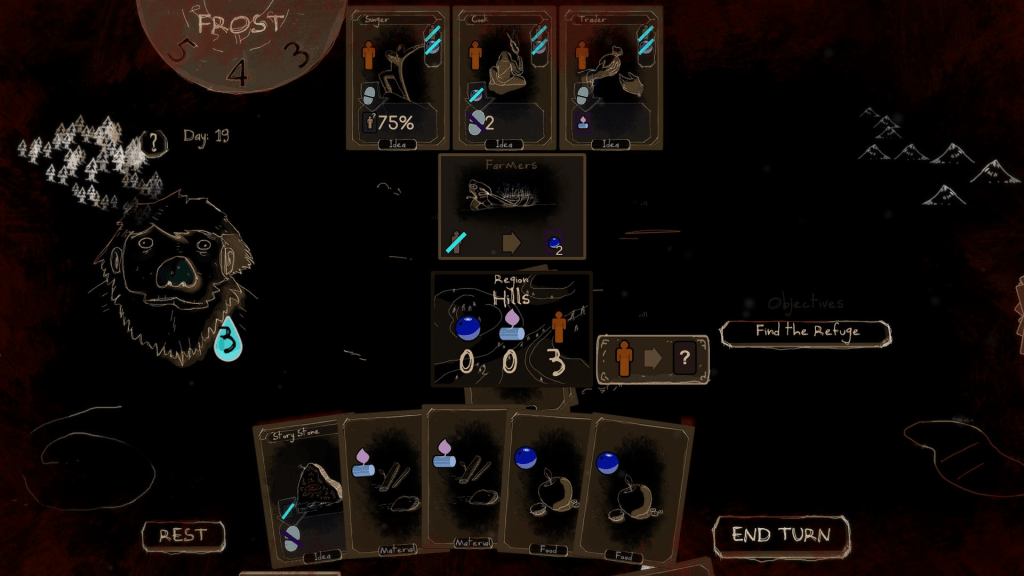
Here’s what it looks like with the Frost one turn away. Thanks to this food card, we can press on, but not without getting bitten by this wolf we can’t kill.

You can ‘beat’ Frost very quickly. I won a run on my second try within 35 minutes of installing it, including the 5-10 minutes I spent with its tutorial. (Reminder: I am not good at video games.) I did this without engaging with or really understanding its deeper mechanics, such as the fact that most cards have secondary functions if another card is sacrificed when playing them. However, it’s worth sticking with for a good number of hours after this point, because you unlock more entertaining modes and classes that modify the challenge. Frost’s equivalent of character classes are ‘scenarios’, which are runs with alternative win conditions or different decks. The Leader, for example, immediately loses the run if anything happens to the survivor cards that represent his family, so you can’t risk sending them off to gather resources or literally throw them to the wolves to save yourself. The Meditator doesn’t have to worry about the Frost catching up, but has to survive for 50 stages, roughly 2.5 times the length of a regular run. Once completed, the scenario characters become playable in the game’s ‘main’ mode, which can be adjusted for different difficulties and play features as desired.

Randomised Elements

There’s a lot of information to consider every time a new round begins. The required cards to beat the round, the items you can craft, and the features or encounters in the current area are all random. Fundamentally, Frost is a game of transactions: if you don’t have the cards you need to progress in your hand, how quickly and effectively can you get rid of them for cards you do need? You can fairly quickly reach a zoned-out state of play where you’re not really ‘reading’ the cards, more just glancing over the icons for their costs and making snap judgements about if you need them or not. I think this is the feeling I always look for in a good deck-builder; the moment when the abstractions of the gameplay fall away and you can feel the flow of its systems working effortlessly. It feels like being able to decipher the code in the Matrix for fun, or something.

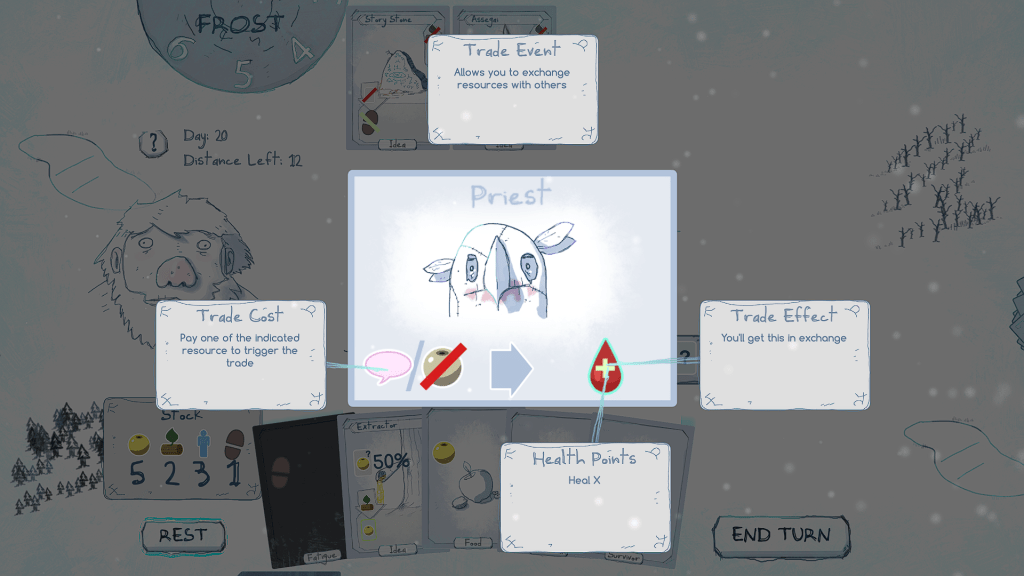
Every card can be right-clicked for lots of detail on how it functions.

Despite this, it did strike me that I rarely came across any new non-starting card during a run that felt like a true gamechanger. Whatever struggles your chosen class face in the early to midgame will likely be the same struggles they’ll face by the endgame, assuming you’ve found a way to mitigate them. It is nice that almost every card you start with maintains a degree of usefulness (except Fatigue cards that just clutter up your hand), but it also means the thrill of finding a card that sounds really useful if you can combine it with other things is missing. Because every card feels fairly disposable, the deck lacks that push-pull satisfaction as it get built. Instead of being good at dealing with one type or threat well or potentially being weak to another, your deck is always either adequate or subpar, and it’s very hard to get a losing deck back on track once it starts going pear-shaped. Given the theme, though, perhaps this is part of the design?

My only real gripe is that one major thing seems dependent on randomisation that really shouldn’t be: unlocking more features. Unless I’m missing something, I believe the only way to unlock new scenarios is to obtain all the unlockable cards for the scenarios you already have. These are earned randomly when completing runs. Sometimes they are earned even if you fail a run. Sometimes you won’t earn anything when finishing a run, and there is no indication of how far along you are until your next unlockable, not that earning them seems like linear progress anyway. An ‘XP to next unlockable’ or redeemable point system between runs would have eliminated this arbitrary frustration. Again, given the game’s tone, perhaps such systems would feel thematically inappropriate. I would argue that unless it’s intended as an art piece before any other concern, a game that sacrifices playability for the preservation of atmosphere may have its priorities mixed up, but with Frost I have no conclusive evidence this is really the case, anyway.

Hilariously, you can turn on a ‘night mode’ that literally just inverts the colours, which looks a bit silly but may save some eyestrain.

Presentation

The game’s About page on Steam describes itself as having “sloppy but graceful unique artwork”, which is pretty spot-on. Almost all the character and card art is rendered in heavy navy linework, with colour only being used to highlight certain facial features and soft grey shadow work doing the rest. I love it when an indie game is able to invest everything it has into honing a particular tone, and Frost nails its own: this place is really cold and dangerous, and you will die if you don’t act. It’s figuratively cold besides feeling literally cold, too. The game is very matter-of-fact about the grim reality its travellers sometimes face, such as playing the Cannibalism card. You lose a survivor and receive two food cards that work like any other, but instead of the usual picture of fruit on the cards, they are represented by slabs of slightly bloodied meat to remind you of what you had to do to get it. Probably the most affecting bit of art design is how the Frost affects the field of play the closer it draws near. When you only have one turn left to survive, black lines start flashing and fragmenting the field of play, with an undercurrent of white noise starting up in the background, perhaps to simulate the terror of oncoming frostbite. Your eyes may not thank you for staring at so much white for extended periods of time, but it builds a good atmosphere. There is very little music, most of it somber chanting and what sounds like horns so distant you’re only hearing the echo of them from far away. Like the visuals, the sound design is intentionally sparse and all the stronger for it.

Closing Remarks

Frost is one of the earliest examples of a roguelike deck-builder that seems to have put as much care put into the tone it wants to convey as it has put into its gameplay systems. Unlockables could be a little less opaque, and the singular, dark setting alongside a lack of card diversity means that it probably isn’t a deck-builder you’re going to come back to for the world or its systems. That said, the speed with which you will likely get a handle on its mechanics is extremely satisfying, and even a little time spent with Frost is likely to stick in your memory.

Standout Cards

As mentioned earlier, few cards in Frost are significantly powerful in all instances. Cards increase and drop in value round to round depending on which ones you need or what you can trade them for.

Idea cards trigger an effect or earn you a resource for a cost. The Assegai is normally handy to have one of somewhere in your deck. For a relatively cheap 1 material, you can do 2 damage to enemies, usually enough to kill them and let you progress without taking damage. However, if the current area has no enemies, it’s a waste of a drawn card.
Event cards are ones that you can choose to engage with or not – a random one is given every new area you move to. Like Idea cards, they usually allow you to manipulate your resources, but they don’t fill up your deck with things you potentially don’t want. Viewpoint here is cheap (1 material) and gives you some control over what the next Event card or resource requirements will be for the next area – a little peace of mind if the Frost is at your heels.
Enemy encounters are also considered Event cards. Cannibals, despite the distressing artwork, are probably one of the better encounters you can hope for. They can be placated with 2 food cards or killed by 2 damage, and you’re fairly likely to draw one or the other by the time you come across them.

RDBG #5: Solitairica (2016)

Solitairica, a name I can never type properly, came to us courtesy of Canadian developers Righteous Hammer Games. MobyGames tells me it came out on PC on May 31st, 2016, followed later in the year by mobile and Mac releases. Solitairica barely made the cut for an entry here. It isn’t particularly rogue-like in its randomisation and your actual cards are just numbers, leaving it up to collectible spells to represent your ‘hand’ of actions. Regardless, it gives me a good excuse to talk about what randomness represents for this genre and the delicate tightrope it walks when keeping players invested with luck-based gameplay systems.

Premise and Gameplay

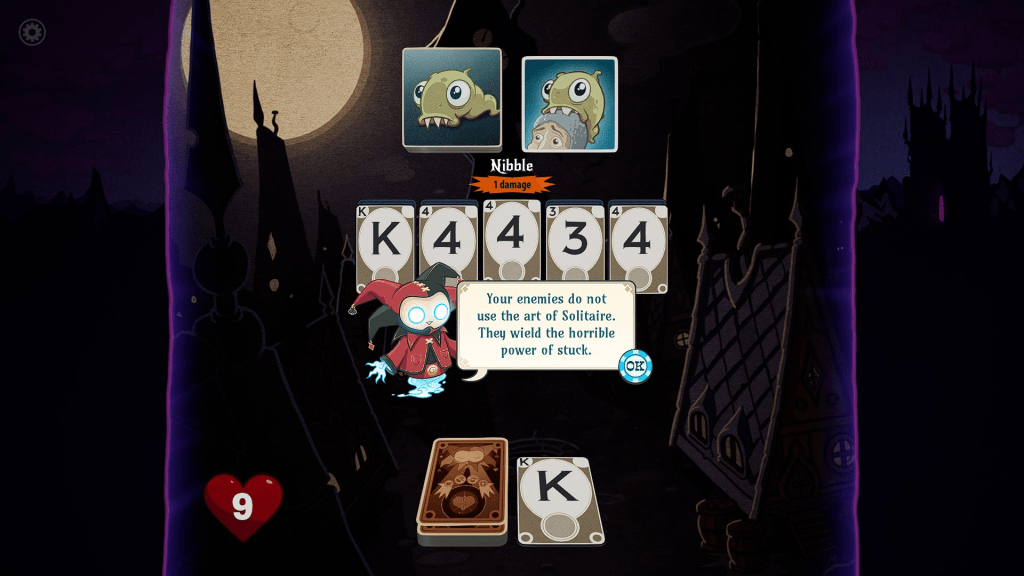
The evil Emperor Stuck has stolen the hearts of all in the land of Myrriod. It is up to you to engage his evil hordes through… solitaire? Well, a heavily-altered, pared-down variant of it, anyway. Your route to the emperor is blocked by 18 rounds of combat. However, the player is the only one matching numbered cards. The enemy, instead, will hit you with RPG-esque attacks and spells that deal direct damage to your hit points, manipulate the field of play, or otherwise interfere with your ability to match your card to one of a number higher or lower than the current card in your hand. You win if you match all the cards, and the enemy wins if they kill you. 

Ghostly jester Kismet teaches you the gameplay basics, and sounds like Midna from Twilight Princess when speaking.

You have some magic at your disposal, and here’s where the game actually qualifies for a post here. Instead of suits, most cards are associated with one of four types of magic – attack, defense, agility, and willpower. Matching an attack card will stockpile one attack energy, which can be saved up and spent on attack spells, which do things like match any one card regardless of what number you currently have, remove all cards of a particular number, and so on. However, you can only have six spells at a time, with new ones being a big drain on the coins you win between rounds, and this is where the bulk of strategy lies. Losing a run loses you everything, except for some gems that can be redeemed to unlock new ‘classes’ (really just different spell type focuses), or extra passive abilities and items for classes you already have.

Randomised Elements

Hmmm. In some regards, this is about as random as these games can get before strategy stops factoring into the outcome at all – that’s inherent to the design of solitaire, though. On the other hand, your runs, or at least the first several battles, will start feeling familiar fast. Surprisingly, the order in which the 17 enemies are presented to you before the final boss doesn’t change. This is presumably done to stop anyone getting too frustrated by getting wiped out before they’ve put a real dent in the run, but after about the fifth encounter or so, you will be at least partly at the mercy of some good luck regardless of your build, and shifting some enemies around would have gone a long way to giving each run its own identity. 

Enemies are introduced with a little bit of description before combat so you can prepare your spell loadout.

Items and spells stocked in the shops are different every time you visit between battles. There aren’t a ton of them in the first place, so you will likely be seeing several of the same ones repeatedly on most runs. On the one hand, this is good because it means you won’t have to play the game too many times before getting a handle on the spells that enable your preferred playstyle. On the other hand, it isn’t much longer after getting that handle you will realise that many spells are just too niche to be consistently useful or worth their energy cost. Your spells’ ability to turn the tide of a losing game back in your favour, much like your enemies and their capacity to turn it against you, ultimately matter little in the face of the number one solitaire concern – ‘can I match my current card with anything?’ Saving spells for the optimal moment when you run out of matchables and being able to get another streak going is a thrill, certainly, but I never felt that it was down to a strategic masterstroke on my part. How much you care about this will be the biggest factor in whether or not Solitairica clicks with you.

Shop wares are randomised and expensive, but you can pay to have something reserved for the next time you visit if you don’t have enough money right now.

This gives me a chance to talk about random number generation. It’s something I haven’t brought up in these posts yet, but given that all of these games are at least partially unified in the luck-based aspect of ‘drawing’ actions, it was only a matter of time. You will often hear ‘RNG’ in derogatory terms online, where it’s often used as a shorthand for ‘luck’. Things like “I got RNG-screwed” or “the game is over-reliant on RNG”. (Looking up the Steam reviews for this very game will get you some examples.) Some randomisation must exist for this genre to work at all, but it’s safe to say that most people don’t like it when the hand of RNG is felt too frequently, or that a run ended prematurely because of factors beyond their control. Solitairica is an interesting case, then, because I don’t think anyone would start a game of real solitaire (or certain variants) or many other card games if they didn’t expect to be fully conscious of the luck involved at all times. That’s what makes these games gambleable, after all; the element of luck keeps them from becoming ‘solved’ games. Whether or not Solitairica works for you, I reckon, depends on how much you mind your games laying bare this simple fact. The cards you needed didn’t come up and you lost, that’s just how it is sometimes, the game seems to say – but here’s some gems that unlock stuff for your time and effort. Whether or not that turns you off or keeps you coming back is up to your tolerance for games of luck where the odds are withheld.

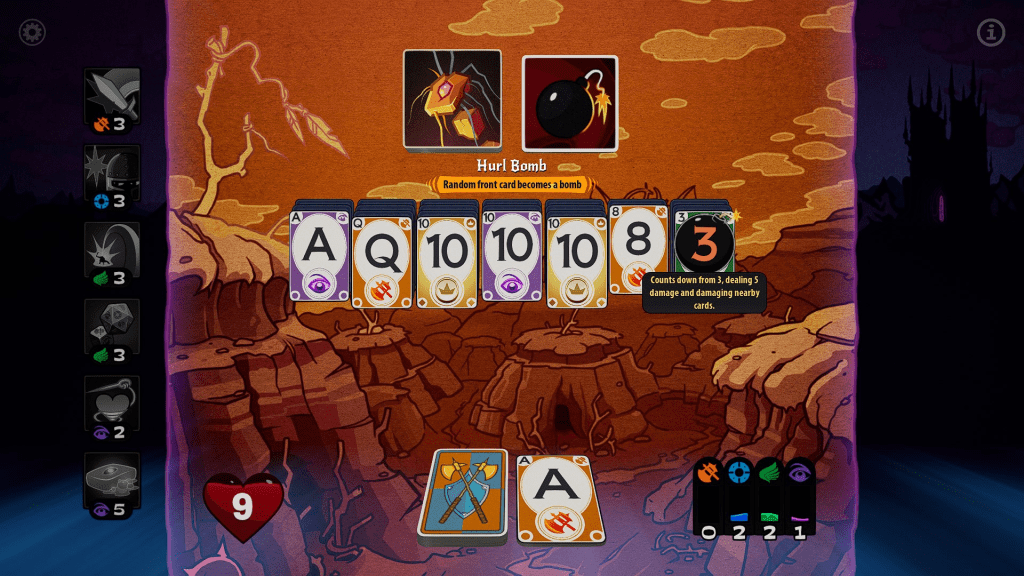
Enemies can mess with the cards in numerous ways, such as these bombs. As you can see, there’s no 2 or K that I can match my A with, so I’ll just have to pass my turn.

Presentation

A very clean and crisp looking game. The sides of the screen have a lot of negative space to hold UI elements – presumably this is just a side effect of the game being built for vertical mobile displays alongside PC. Character and enemy design may not blow you away, but should at least get a smile or two here and there. Several spells come with a little bit of animation and flair once triggered. These don’t slow down proceedings, and are just enough to give you some satisfying feedback when a skill you saved up pops off. As for music, there’s not a whole lot of it to go around. Combat itself is silent except for some nice sound effects, so you’ll want to be supplying your own background distraction. All in all, the land of Myrriod is hardly one that’s so compelling that you’ll be thinking about it when you’re not playing, but everything looks and feels functional. Not to damn it with faint praise, but it clears the minimum requirements it needs to, and sometimes that’s fine.

Closing Remarks

I’m definite that Solitarica is one of the more polarising games I’ll cover here. I’m not interested in reducing the games written up here down to a yay-or-nay. People put a lot of effort into making these with (usually) good intentions, and they are often dirt cheap compared to most modern games, so I fully encourage trying these out for yourself. That said, I wouldn’t blame anyone for totally bouncing off of Solitairica. I can take or leave solitaire myself, so for all I know this may not even be your bag even if you are into the genre. Like Guild of Dungeoneering and Hand of Fate before it, the game seems to steer you toward beating its campaign rather than engaging with it for the intrinsic satisfaction of the gameplay. Novelty value alone certainly carried me for a good several hours with it, but I dropped off long before I got around to unlocking the majority of alternate decks. I wonder what a sequel could actually do to refine it further. There isn’t much that it does wrong that isn’t simply a side-effect of the intended gameplay, and giving the player better spells and greater agency could quickly make the game too easy. Food for thought…

The game certainly isn’t hurting for character names, at the least. (Again, I can’t play my 6 here – Pass!)

Almost irrelevant aside that doesn’t fit elsewhere

There was a 3DS game called Pocket Card Jockey (released in the west a month before Solitairica, funnily enough, with a mobile sequel out… literally eight days ago), developed by Pokémon dev Game Freak. In brief, you race horses, and to make them go faster, you have to solve solitaire hands as fast as possible. I bring it up because the solitaire gameplay was simply an engine for the greater goal of placing higher in the horse race. You could be bad at the solitaire and still finish the race, although probably not very well. It makes me curious if a version of Solitairica where the solitaire supplements combat based on the spells could work. Good solitaire luck/skill could get more spells out quicker, and perhaps your health wouldn’t replenish between fights, and that’s your incentive to play smarter and faster. Of course, this loses the original’s sedate turn-based nature, which isn’t for everyone, but I’m just thinking aloud at this point.

Standout Cards Spells
Well… this is an odd one. The game uses a +1/-1 solitaire playing card system, albeit without suits. What am I going to do; tell you that the 6 of hearts is OP or that they need to nerf the queen and jack synergies? Rather than the actual cards, I think I’ll use this space to talk about a few good purchasable spells I found handy, since they more closely resemble the functions of cards in other roguelike deck-builders.

Requiring a fairly cheap 5 attack energy, Intimidate is handy for those awful moments when you’re staring at a bunch of cards with the same number that you can’t match turn after turn. It doesn’t happen often, but it’s nice not to have to worry about it when it does.
Shadow Stalk costs 5 agility energy and requires some careful thought. Triggered at the right time, it could set you on a matching streak that easily puts it among the most valuable spells in the game, but I’m always second-guessing myself on when to use it and missing my chance.
Arcane Missiles is much more my speed. 6 willpower energy, three random cards gone, no questions asked. The added bonus here is that willpower energy is often just used for healing and the like, so if you’re blocking well or stockpiling health, you’ve probably got a fairly ready supply of it incoming to pop this off when you can’t match anything.

RDBG #4: Guild of Dungeoneering Ultimate Edition (2015)

Guild of Dungeoneering was developed by Irish developer Gambrinous on July 14th, 2015. Here, I’m going to be looking at the updated ‘Ultimate Edition’, which comes with a long list of extra features. Having not played the original base game, I’m not sure how representative this will be for anyone who played it back then. I should note that these retrospectives will typically cover the latest updates and DLC available for each game at the time of writing.

Premise and Gameplay

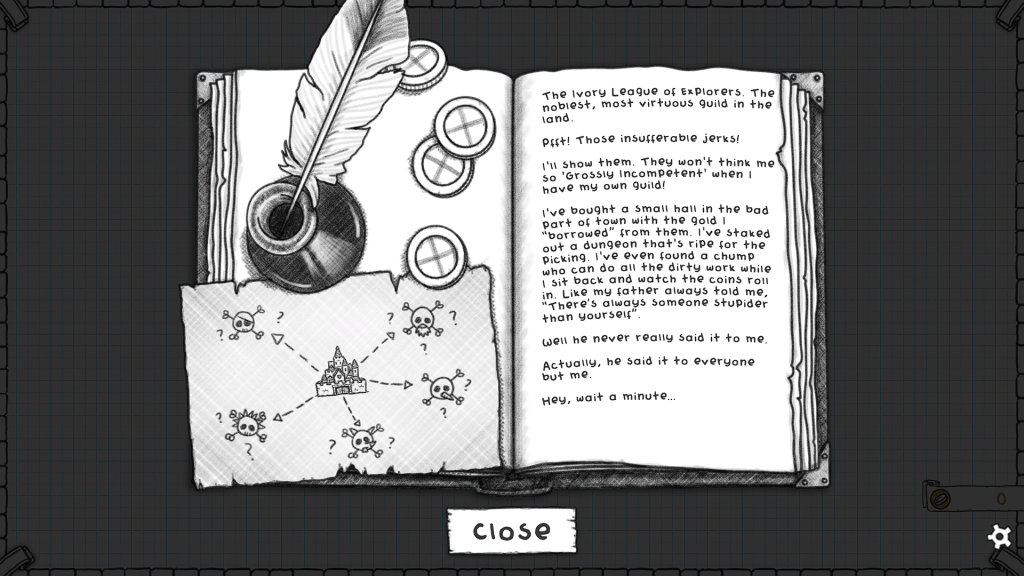
GoD starts out with you making a character and putting them in a tiny starting base. You go on short dungeon crawls with a view to returning alive with new goodies with which to expand the base. This unlocks new ‘dungeoneers’ of various classes, new loot to be found in dungeons, and new boons to give you advantages early in each dungeon run. There is some light and slight story to be had: your adventurer, having been deemed too incompetent to hack it at the Ivory League of Explorers, is setting up their own rival faction on an adventure that sees them taking on such threats as pirates, the Dwarven Mining Conglomerate, and monks guarding an ice cream formula.

Setting the tone right out the gate…

Combat plays out with the familiar turns being taken between you and an enemy to play cards. However, it has some peculiarities unique to its design. First, unless you have a card or equipment with the Quick feature, enemies will always go first each round, something that transformed the aggressive way I normally like playing these games, forcing me to think much more defensively through my first several runs. Secondly, damage and health numbers are much lower than in similar games. The most powerful damage dealing cards you’ll see in an early to mid-game run will likely only do around 3 points of damage at once, and a fully-levelled dungeoneer or end-of-run boss will likely only have just over 10 health points maximum. With such low numbers and blocking, physical, and magical actions being available, combat begins to resemble something like a version of rock-paper-scissors where you know what move is coming, but you can only play two of the three choices in any one round. This keeps battles and runs themselves very short and sweet; rare is the run that will take you longer than 20 minutes.

GoD’s twist on the roguelike deck-builder is that cards are not only played in combat, but also played to construct the dungeons around you as you explore. Entering a dungeon will give you a handful of often-unconnected rooms. Between battles, you can place three cards to alter both the layout of the dungeon and how your character moves around it. You don’t directly chart your adventurers’ paths – they will quite happily automatically run into a foe that outlevels them unless you divert their path by luring them elsewhere with loot. There’s almost zero depth to it, but it does provide a bit more agency and puzzle solving than just clicking on a map waypoint.

It’s generally always a good idea to place enemies the same level as you to level-up faster.

Your incentive to minimise run losses is a pseudo-permadeath whereby fallen adventurers are gone for good, and you may have to wait a further run or two for another dungeoneer of that class to sign up at your guild. This highlights a flaw in the gameplay loop: dungeoneers who survive enough runs will gain passive traits that make future runs easier, but the game can never throw anything at you that would fully engage these traits because it can’t assume that you actually have any of them. Conversely, the longer a dungeoneer survives and accumulates more and more traits, the less likely anything can kill them unless they have some bad late-game luck.

What character classes have we got on offer this time? There’s 15 to the base game and an added 6 to the Ultimate Edition, and they’re a wacky bunch. The Mime’s playstyle, for example, revolves around forcing the opponent to replay cards that they may not want to play multiple times. The Yodeller has a completely broken mechanic whereby unplayed cards become more powerful when they get reshuffled and redrawn from your deck, meaning your victory is only a matter of time unless you encounter something that outlevels you early on. Class balance doesn’t seem to have been much of a concern: some dungeoneers just won’t stand a chance in certain runs, while others trivialise most of the game (the Ultra Chump comes to mind). Unfortunately, this means that the game’s only real way of upping the difficulty in later dungeons is to put you up against harder enemies sooner, which can put you in a loop of losing several dungeoneers and just cycling through different classes until landing on one that has an easier time of it. This difficulty imbalance means the game is almost always just that little bit too easy or too annoying, with skilled play rarely being the difference that keeps you in the sweet spot.

I didn’t realise how poorly I’d slapped together my guild’s base until I took this screenshot. For shame!

Randomised Elements

The game is actually fairly light on the randomised stuff. If you fail a run, the pre-set dungeon tiles and enemies will be the same, but you can choose a different path through it. While you can develop your deck by picking up equippable armour and weapons for your hero, you can’t alter the deck that you shape your dungeon path with. You straight up never get or lose cards for this purpose. It’s understandable why you can’t, as it would likely make the game so easy as to strip the dungeon-shaping of all purpose, but it’s rarely fun when you draw a hand of room tiles that don’t fit anywhere you want to steer your hero and just have to wait for the next turn.

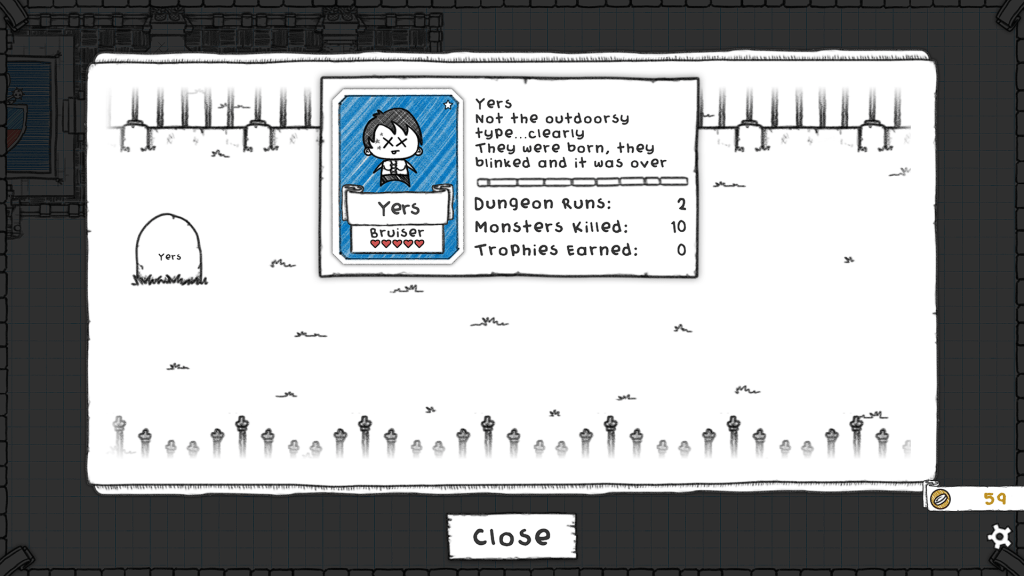
Fallen dungeoneers’ gravestones are sized according to how many dungeon runs they survived. Poor Yers here will not be one for the history books.

This is less of a problem with the randomness in combat, because decks are extremely small and individual cards usually only do one of six things (physical/magical attack, physical/magical block, heal, status effect) or some combination thereof. Here’s the key difference between DoG and something like Slay the Spire. The latter is infinitely playable because you’re playing for the enjoyment of engaging with the systems more than finishing the game. Guild’s 30 or so dungeons subdivided into three runs each make it very much a single-player campaign that you are playing because there is a beatable end-point to be reached. There’s nothing wrong with that, either: like Hand of Fate, it’s simply a different set of decisions on the part of the developers in where the game’s fun lies. An upside to this lack of depth, I found, is that I was almost never struck with ‘hand paralysis’ like I so often am in StS, where I have multiple viable plays at my disposal but the stakes are so high I spend far longer thinking about them than I would sometimes like. Whether or not you think this is a worthwhile tradeoff is up to you, but it is a bit of an apples-and-oranges situation in the first place.

Presentation

As you’ve likely noticed from the screenshots, the whole thing is put together with this wonderful pen-and-paper artstyle. Playing your room cards and seeing them manifest on the large graph-paper backing is charming and sometimes even oddly touching – I wonder if the developers have memories of charting maps on paper if they played Wizardry-style dungeon crawlers or using physical maps for Dungeons & Dragons. It feels too well-realised an aesthetic to simply be a throwaway visual gimmick. The handwriting-style font, the limited hand-drawn assets to make new characters from, and the humour added to most of the speech and story means that DoG really knocks it out of the park on effort if the tone clicks with you.

Defeated enemies have the ‘paper’ they are drawn on ripped to shreds – one of those authentic ‘we, the makers, care deeply’ touches that warms the heart.

Another thing that struck me is the surprising frequency of music with vocals – winning a run or unlocking new dungeons tends to bring with it a burst of bardsong accompanied by a riff on the main theme. I enjoyed it for the first half hour, but you get hit with one of these every single time you win a run, lose a run, unlock a hero, sneeze on your keyboard, anything. It started to drive me a bit mad long after it had stopped being funny. The singer pokes fun at your dungeoneers being unreliable novices, but once you’ve amassed a handful who’ve survived a few dozen runs where nothing they killed could hope to threaten them, it just comes across as being irrelevant and condescending. It’s the only part of the presentation that lets the side down, because otherwise it looks cute, has the occasional laugh, and handles very nicely with either a mouse or a controller.

Closing Remarks

Dungeoneering is not a game you will stick with for its deep gameplay or replayability, but you will quite easily get your money’s worth. I think there’s a real place for a roguelike deck-builder that is on the less mentally-taxing side with its strategy. This one was a real joy to pick up and blast through a dungeon or four after a long day at work. When I’m tired, I don’t always have the galaxy-brain energy to have a go at some of the more challenging (if better-rounded) games in this genre. Sadly, its difficulty and class balancing problems will keep it from being a genre stand-out, but there’s good, simple fun to be had and none of the transparent cynicism behind its creation from the average Slay the Spire quick-buck clone we’ll be seeing soon enough.

Standout Cards
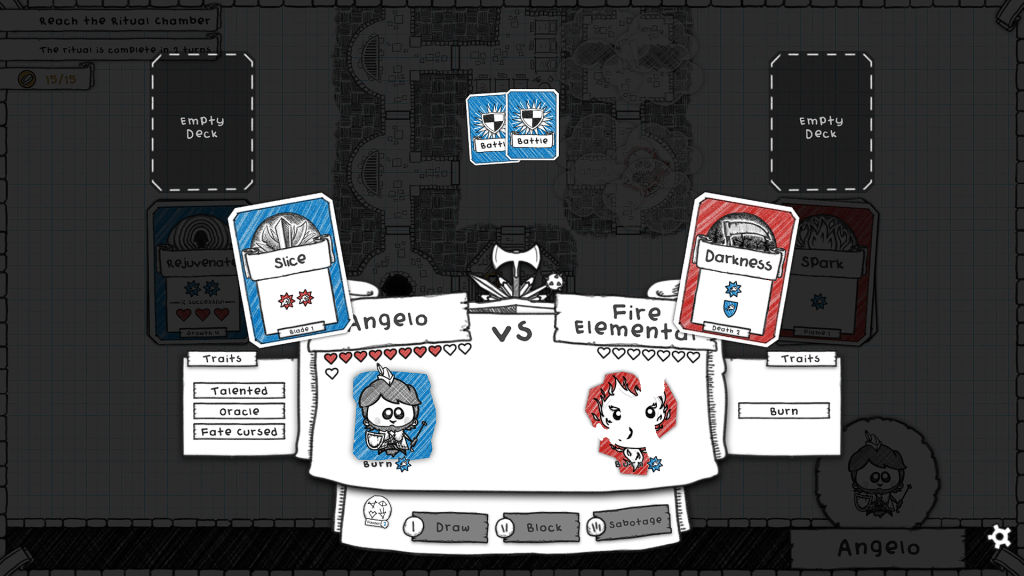
The funny thing about DoG’s cards is that they are often really basic, and several don’t even have words – simply icons representing common actions like healing, attacking before opponents, and so on. This makes cards extremely quick and easy to read in gameplay, but a little harder to choose standouts. The obvious thing to do would just be to fill this section with the ones with the biggest damage or blocking numbers, but where’s the fun in that?

Dealing two physical damage before the enemy does anything may not seem particularly fantastic, but Eyes Closed Punch has won more fights than any other card I think I used the whole game. Finishing off something nasty quickly, even if it can block for one damage, is always worth keeping in your back pocket.
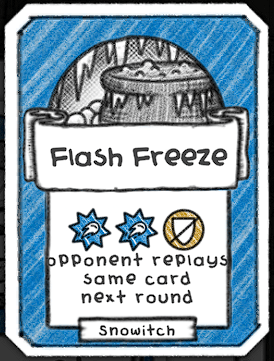
Two unblockable magic damage is already great, but trapping your opponent in a card they don’t really want to play twice in a row? Priceless.
Fourth-tier cards are generally all ridiculously good, but blocking all physical damage while adding an extra two damage to your next physical attack makes this a no-brainer to pick every time you come across it.

RDBG #3: Hand of Fate (2015)

The third entry to meet my criteria is already one of the more unique: it is as much an action RPG as it is a roguelike deck-builder. Released through Steam Early Access on July 7th, 2014 and receiving a finished build on February 17th, 2015, Hand of Fate was crowdfunded by its Australian developer Defiant Development. It received a sequel in 2017, and its use of reflex-dependent combat makes it a take on deck-building that still feels special in 2022.

Premise and Gameplay

Hand of Fate pits the player against ‘The Dealer’, a mysterious cloaked figure who serves as antagonist, opponent and narrator. Upon starting a run, the player and the Dealer mix together cards of their own choosing to form a deck that serves as both a game board and resource system for the third-person combat encounters (think of a very stripped down Arkham Asylum or Bayonetta). With a number of these cards set face down on the table, the player chooses a path from card to card, turning them over and triggering choose-your-own-adventure-style events, traps, rewards and encounters in the hopes of finding the one that allows them to exit the area and progress to the next one until either the boss or player is defeated.

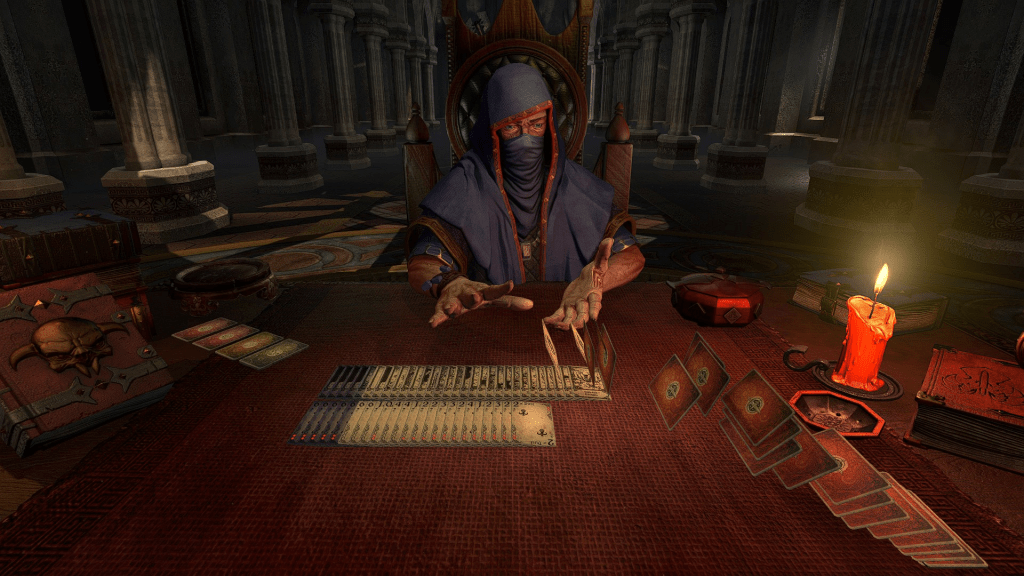
The Dealer in the midst of mixing an upsetting number of encounters into the shared deck.

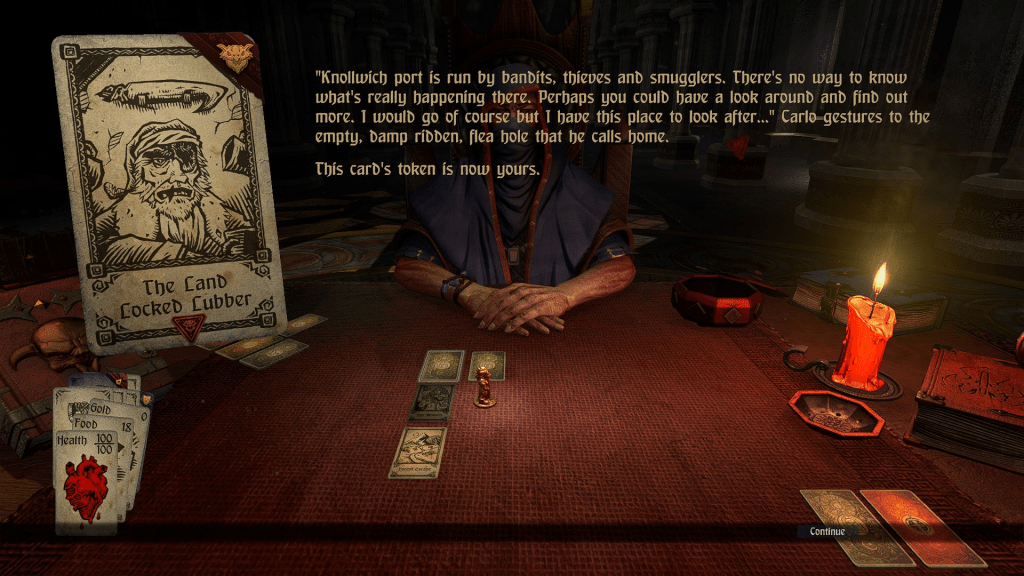
The choose-your-own-adventure comparison is apt. You don’t play cards against each other. Rather, each card you choose will outline a scenario your adventurer finds themselves in and then present you with choices (often luck-based to resolve) to decide the outcome. For example, the Hero’s Remains card sees you coming across a funeral for another adventurer and you are asked to return their sword and shield to their hometown. Your options include using them for yourself or returning them to their rightful place for a different reward – both options will curse you if you don’t reach their hometown card quickly enough. Resolving a card’s scenario in a certain way often unlocks ‘sequel’ cards that build on the scenario or its relevant characters if you add them to your deck for future runs. Given this piecemeal approach to narrative, you won’t learn a lot about the totality of Hand of Fate’s world by the time you finish, but the vignette approach always keeps you wondering what’s waiting behind your next step.

Card scenarios oscillate between darkly humourous to… just dark.

Further variation is added by choosing a ‘fate’ before the run – functionally a character class, but with the potential to run into unique scenarios or cards. The Wildcard DLC pack adds an additional 9 fates, with some really out-there variations. One of my favourites is Iron Hunger, who eats equipment instead of food, a resource needed for movement and healing. I got through a significant chunk of the game with your bog-standard adventurer, but whoever you choose, it isn’t going to transform the experience of combat as significantly as choosing a different class in Slay the Spire or Dream Quest does. You will still be whacking a lot of things in real-time.

Let’s talk about that action combat a bit. It’s not the deepest of its type, but I would argue that you probably do not want to overcomplicate the twitch combat when the card gameplay is having such an impact on how you deal and receive damage. When a fight starts, you will be put up against a number of foes. Options include dodging, deflecting projectiles, and using artefacts gained from cards that create effects like calling lightning onto enemies or temporarily repelling damage. Incoming attacks can sometimes be dodged or countered with a well-timed button press, but when you’re getting properly ganged up on by six or more enemies, it’s often better to try to split them up and defeat them one-on-one. End-of-run boss fights are decently challenging, but late game battles can get a bit frustrating if you stumble across enemies before you’ve had much chance to gain adequate equipment.

Defeating the last enemy in an encounter triggers a ludicrous slo-mo effect as their body ragdolls in reaction to whatever you last did to them. Hilarious.

Randomised Elements

This is the first game we’ve seen that lets you have some direct selection of what cards may show up over a run before it begins. These runs are not totally random every time. If you choose the same ‘chapter’ multiple times, you will gain a sense of what cards The Dealer is going to shuffle in, and as such get an idea of what threats you will come across and prepare your portion of the deck accordingly. The main story takes place over twelve of these chapters, and I was having a reasonably easy time until the final three chapters, at which point the The Dealer takes the gloves off and shuffles in some real beasts to ruin your day. Even if you know they’re coming, you just hope that they come your way in such an order that you can pick up some good resources first.

Herein lies the key weakness to HoF’s deck-building, which is that you rarely need to do any deck-building of your own. Completing a run will usually unlock a handful of new cards for future runs, and it wasn’t until multiple run failures near the end of the game that I started trying to actually make my own decks. Before then, I was more than happy to hit the ‘Recommend’ button and just have the game rotate in the new, often strictly-better ‘sequels’ of cards that I’d just used from my previous run. Because there’s rarely much headscratching to be had over composing your deck, this makes it all the more apparent that you are at the mercy of luck in later runs – if I’m already outfitted with both what I and the game think are my best cards, why is there such disparity in how far I get before getting crushed in multiple runs of the same late-game chapter? It could be that I’m not particularly good at the combat, but I’ve been playing action games a lot longer than I have deck-builders, and it wasn’t until the end of the game that I started needing multiple runs to beat chapters. The game gets a lot harsher with health and resource penalties and throwing up inopportune encounters that you’re in no state to fight. Patience becomes a greater asset than skill at this point.

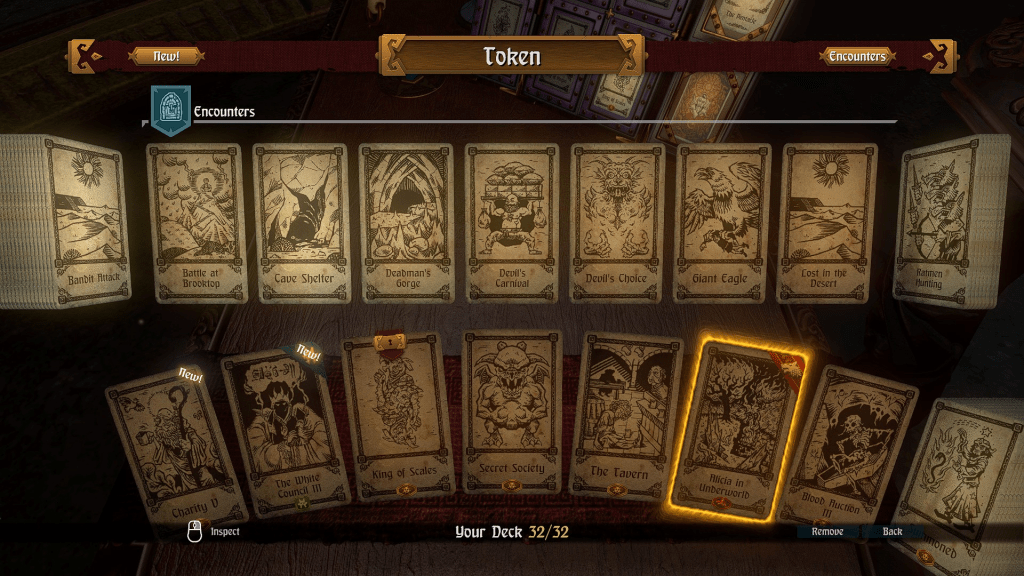
The artwork is wonderful. Even though I didn’t do a lot of deck-building, I found myself here a lot just to admire the cards.

Presentation

Seven years down the line, you can still crank the settings on Hand of Fate and have it looking very nice. Some odd lighting decisions oversaturate bosses and darken their surroundings during their intros, which is a shame as they represent some of the game’s more interesting visual design. Great care has clearly been taken to have the game feel like a one-on-one with a mysterious opponent who only gives you glimpses of their personality and worldview as time goes on, helped in no small part by the wonderful voice acting of Anthony Skordi. Seams begin to show the longer you play. The Dealer will start repeating his clips of dialogue sooner or later, and while it doesn’t break immersion it may become a little wearing to hear a repeated observation on your fifth or sixth attempt of a late-game run. Lastly, I have nowhere else suitable to add this, but I insist on drawing attention to it: upon defeating the Queen of Rats, The Dealer warns you that “a million half-orphaned rats will fall upon you like a tide of horror”. What an excellent quote. I dream of quitting a job with a line like that at the ready.

The Jack of Skulls does in fact have a face, you just wouldn’t know it from his intro, where he’s apparently in the headlights of an oncoming truck.

I’d also like to give credit to Jeff van Dyck’s score, exciting and understated in equal measure. It does a great job of adding tension to fights but also knows when and how far to take its foot off the tempo for a hint of ambience when you’re simply choosing your next path. One bit of cinematic flair that I find never stops being thrilling is the shuffling of your deck together with The Dealer’s upon starting a new run, which is accompanied by a galloping bit of acoustic guitar work. Like a good TV intro, it really gets the hype going for another instalment.

Closing Remarks

Hand of Fate is worth your time if you want a more visceral interaction with your deck-builder. In particular, its early to mid-game, when it still has a lot of new events and equipment for you to try out, makes for compulsive playing. However, it is strange for a game in this genre to feel this apparently mechanically shallow or offer this little replay value. Beyond beating story mode, assuming one has the patience to power through several unlucky endgame runs, all that remains is Endless mode if you really like the experience on offer, and that’s about it. The DLC classes offer some interesting twists, but I think the game’s world and tone would really have to click with you personally to keep you coming back after beating it. I’m very much looking forward to seeing which of these rougher edges the 2017 sequel rounds off. With some further refinement, I think there’s a real winner of a concept to be found here.

Standout Cards

Mister Lionel becomes a recurring character throughout many of the game’s cards, often making dangerous propositions in the hopes of mutual gain. This one often shows up early in runs, providing a basic reward and a little levity. We never get the whole story behind Mister Lionel, but we don’t need it – it just makes for good flavour.
Several other cards hint that the game’s world is grim, populated largely by the doomed. The Lonely Bard is a follow-up to The Lovers and Angry Guild Master cards. He has become an alcoholic after the woman you helped him escape town with abandoned him. Fail to pay him coin and he plays a song so bad it lowers your maximum health.
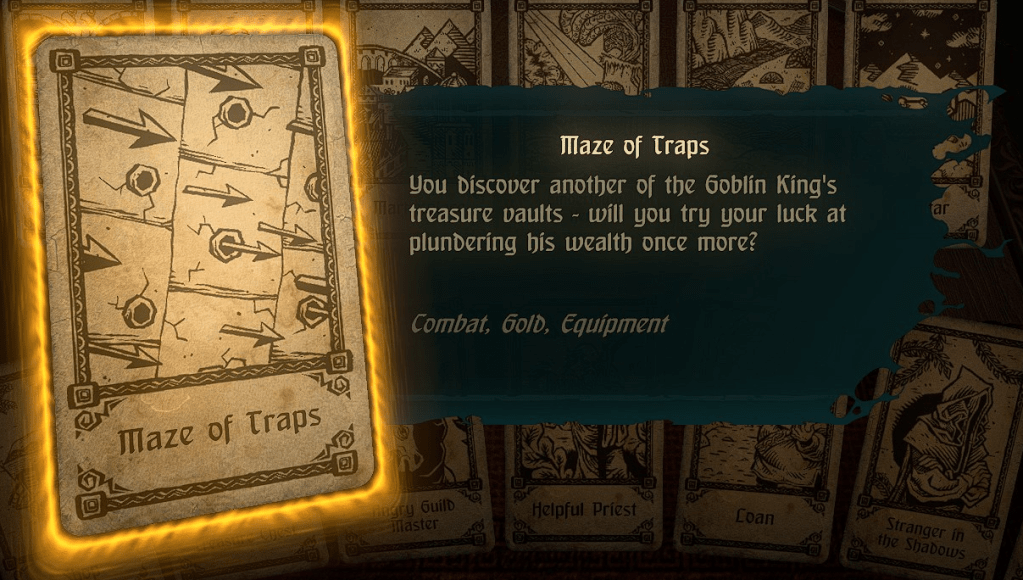
Maze of Traps is quite special because it triggers mazes that must be navigated via the combat engine. They can be a tad overdesigned, but they demonstrate an initiative for using gameplay mechanics in ways other than their basic intent, which is to be applauded.