Lost Your Marbles (Playdate S1 #5)

Release: September 15th, 2021

Developer: Sweet Baby, Inc.

Only a handful of titles in and an identity emerges for the Playdate as a system home to indie concepts that may not have strong enough legs to get noticed in a world as thick and fast as the world of PC games, but are unusual enough to take advantage of a good hardware gimmick. Without wanting to be reductive, I’d liken them to being particularly beefy WarioWare microgames. Here’s one that sounds like two particularly unlikely pulls from a hat filled with game mechanics: a visual novel with tilt controls.

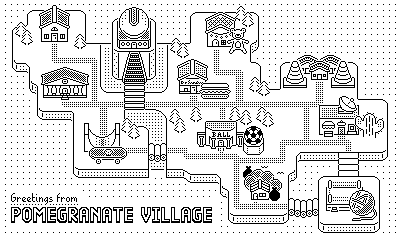
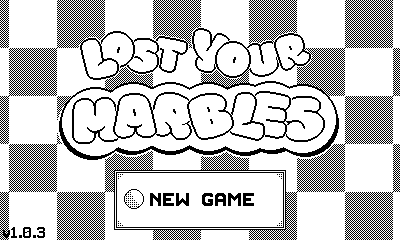
The annual Festi-Ball is approaching for Pomegranate Village, and you, Prota, take your dog Minty over to Prof Marbel’s lab to help out. Hijinks ensue and the prof’s invention for the festival scrambles Prota’s brain, which leads to Minty going missing. What follows is an hour-ish of dialogue with the colourful cast that populate the village as you try to track down the dog, minus your usual mental faculties.

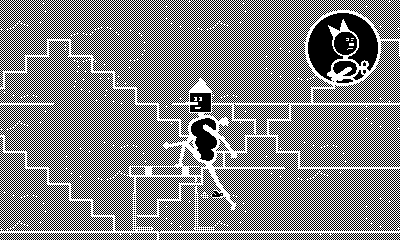
The primary engagement – and humour – comes from giving responses to NPCs via marble mazes. A marble is dropped into a maze (ostensibly Prota’s confused mind) and you must guide it to one of several possible goals that leads to what she says or suggests next. The entire maze is tilted with the crank, as opposed to controlling the ball directly (this feels like a 2D Super Monkey Ball). For example, on my first playthrough, I ended up making a pretty good missing-dog poster, which Prota suggested be printed on thick card stock with a great image of Minty, thanks to some careful marble guidance. However, later on, when ordering a sandwich that might lure Minty as bait, the harder maze led me to make one with protein powder and cactus toppings. The marble itself has a very good amount of inertia to it, but certain mazes are quite difficult to manipulate or get your bearings in. I imagine this can lead to frustration if you’re gunning for a certain outcome or all the endings, but for the first couple of playthroughs, getting these unintended consequences usually leads to a good chuckle.

Like Casual Birder, Lost Your Marbles combines two extremely different concepts that actually do well together for their short runtime. You probably wouldn’t want peanut butter and ice cream for every dessert, but it turns out it can be surprisingly nice in small doses. As such, many of LYM’s best moments are ones that make you laugh out loud. Because it’s short enough to blast through in under an hour, it’s easy to do different types of playthrough: are you going to do a run where you try to whip up the worst missing dog poster possible for the laughs, or are you going to try to take it slowly and go for the ‘best’ options you can? Patience will likely wear thin before you 100% it, but I’d say this is one of the best poster children for the Playdate I’ve yet to come across. Sounds weird and is weird, yet remains a novelty with a good amount of substance.

Boogie Loops (Playdate S1 #4)

Release: September 16th, 2021

Developers: May-Li Khoe, Andy Matuschak, Andrés Velasquez

A weird one on a system of ‘weird ones’. Boogie Loops is a music tracker (a type of synthesiser) in the vein of the music-making components of creative software games like Mario Paint or WarioWare DIY. Crank usage is the most daring I’ve seen yet: none at all. This is the first Playdate release in Season One that doesn’t feature a unique function that only the crank can provide. In fact, it’s probably the first game to seriously chafe at the system’s limitations. Then again, calling it a game at all may be a bit strong. Like Whitewater Wipeout and Casual Birder, it did get me thinking more about what the Playdate’s ethos and purpose in the modern handheld world is than the software itself. 

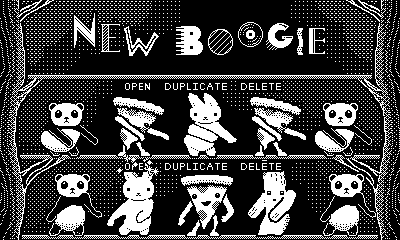
Boot it up. No title screen. Half the screen will be occupied by cute creatures dancing in time to a sequence of notation on the bottom half. A pre-made beat and melody far beyond anything I have the skill or patience to approximate can be played and altered right away. There isn’t any in-game documentation as to how to engage with it. While you’ll certainly wring more out of it if you have a rudimentary understanding of music theory or how to use a tracker, you’ll still have to find out through trial-and-error what odd sound sample each piece of iconography represents.

Part of the Playdate’s appeal, it seems, is that it wants to instill a little bit of mindfulness in your gaming diet. Games may not be cheap these days, but they are plentiful. At the time of writing, it is 2024. Despite being considered a ‘slow’ year, there is still more coming out than any one person could reasonably keep up with. I really feel for indie developers (and, increasingly, even major ones): you toil on a project for years and if you’re lucky you’ll get 15 minutes of fame and recoup costs before it gets lost in the sauce of constant, unrelenting big name releases and interesting smaller projects. Because the Playdate serves you two games weekly (with more available individually at a price), it encourages you to stick with them until next week. I wouldn’t give Whitewater Wipeout a second look if it was free on Steam, but the attention afforded it by being one of my two weekly games meant I stuck with it longer.

Like Whitewater Wipeout, I would say that having this be the fourth ‘game’ out of the gate in your system’s first season of 24 games is a little early, but I don’t want to levy that too hard against Boogie Loops itself. If it’s your first time seeing a music tracker, then its cute and lively presentation, with absolutely zero direction as to how to use it or what things do, encourages experimentation. Unfortunately, unless you have tremendous patience, then its limited utility and the frustration of having to haul the cursor across the screen with the D-pad (as opposed to a mouse pointer or touch screen) quickly makes the process feel like a chore.

If I presented this to someone who doesn’t normally play games I’m sure they’d probably get a curio’s fun out of it over a cup of coffee. I could imagine a younger me, without anything else to ‘play’ until the next birthday or Christmas rolled around, would have persevered a bit more, worked out how to make good things by tinkering around, and possibly even discovered I actually seriously enjoyed music at a much younger age than I actually did. As reality stands, the best Boogie Loops did was remind me of the (far more fully-featured) KORG applications on the 3DS, and to get around to properly configuring my DAW to better record my actual guitar and bass. Nevertheless, it fits an emerging subtext in the Playdate release schedule: don’t rush. Take your time. Remember to have fun.

Crankin’s Time Travel Adventure (Playdate S1 #3)

Release: September 15th, 2021

Developers: uvula, Matthew Grimm, Shaun Inman

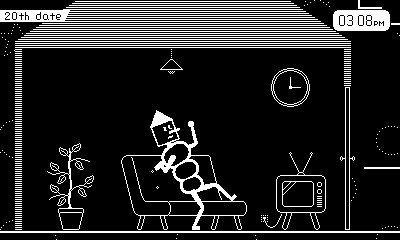
Building block-based narcoleptic Crankin needs your help to arrive late to dates with his extremely tolerant girlfriend. The crank is the only way to interact with the game. Turning it clockwise moves Crankin forward in a manner akin to playing a music box. Turning it counterclockwise ‘reverses’ him. Pacing is key: Crankin’s girlfriend won’t hang around forever, so you will have to be cautious about when you choose to speed up, slow down, or turn back. Between Crankin and the earful he deserves are numerous enemies that cannot be directly defeated, only avoided. The biggest name behind Crankin is Keita Takahashi of Katamari Damacy fame, and it was screenshots and footage of this game that was doing a lot of the heavy lifting for the Playdate when it was being demonstrated pre-release.

Crankin calls its levels ‘dates’, and I greatly enjoyed the first ten or so. The novelty of the sound effects and stage elements speeding up and slowing down in real time with how quickly you spin the crank never really gets totally old. Unfortunately, the game goes on for fifty levels. The wheels fell off for me in this order. First, the limited view of what’s in front of Crankin’s (very large) figure makes it difficult to see enemies until they’re already on-screen and almost undodgeable, reducing most levels to a repetitive challenge of trial and error. This is a problem people had solved as far back as the first Game Boy with Super Mario Land in 1989, if not earlier: keep your sprites and level elements at a small scale for small displays. Crankin can’t take a single hit from anything, and stepping on dog crap will kill him as handily as getting trampled by a stampeding pack of pigs, so back to the start of the level you go. Second, you realise this is the whole game. I wondered why the official Playdate website categorises this as a ‘Racing’ game, but as I played more I gradually realised that’s a fitting tag. It has a Trackmania or Gran Turismo-esque time attack feel to it, where the only way to get to the end faster is to memorise the order of obstacles over and over again until you do it perfectly. The final nail came when my sense of pride in beating a level immediately evaporated because my reward was always just another, usually even harder, level. I call this the ‘screw you’ gameplay loop. The novelty of new level elements immediately wears off because you’re only beating levels out of spite. I tapped out on Crankin around the 25th date. I’ve stopped talking to more than one person in real life because they weren’t able to stick to appointments way fewer than 25 times, and I’d advise Crankin’s girlfriend to do the same.


Let’s finish with the good, because I found a lot here before it started to grate with me. The visuals take full advantage of it being a Playdate game: completely black, with characters and obstacles being etched with white outlines of varying thicknesses. I’m not sure if I can call something that doesn’t use colour ‘vibrant’, but for a game as full of negative space as this, it certainly achieves a lively whimsy that exceeds what you may expect from the device. In a touch I’ve never seen another game do on hardware orders of magnitude more powerful than the Playdate, the game’s animated home menu icon (an adorable Crankin asleep on his sofa, as he is at the start of every level) seamlessly transitions into the game itself once booted. That’s absolute magic. As with Casual Birder, the Playdate’s powerful sound capabilities are proving to be one of the system’s secret weapons: Crankin has some great SFX, and hearing them get stretched out or reversed in time with the crank manipulation brings back memories of playing records at speeds you shouldn’t. Ultimately, this one had the steepest novelty-to-irritant drop-off of any Playdate game I’ve tried yet, but its commitment to doing things that only this system can do is still to be admired.

Casual Birder (Playdate S1 #2)

Release: September 15th, 2021

Developers: Diego Garcia, Max Coburn

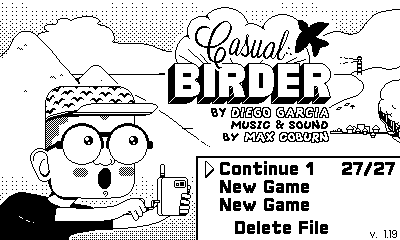
A top-down adventure where you mosey around a town, talk to people, and take pictures in the run-up to a bird photography contest. In contrast to the arcadey Whitewater Wipeout, this one is more of what we might expect from a modern indie game: a tone, a well-executed gimmick, an afternoon’s worth of gameplay, and a special little world that doesn’t overstay its welcome or feel underexplored.

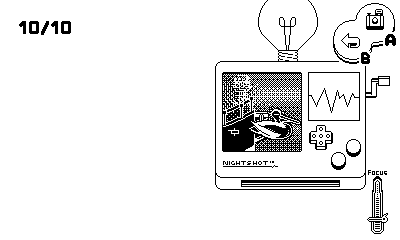
Let’s get reductive. It’s a 2D Pokemon Snap demake with its tongue in its cheek. Your character moves into a new town and receives a little birding encyclopaedia to fill. There’s even a rival team to roadblock progress. With only 27 birds and being a strictly single-player experience, there’s only so much to be done. That’s grand, because the little journey is packed with love and silliness. The crank’s main function here is to focus your phone’s camera to take better shots of birds. This doesn’t get old, mostly because the game usually creates puzzles around locating the birds themselves rather than requiring any particular dexterity or timing with the picture taking. This was absolutely the right call.

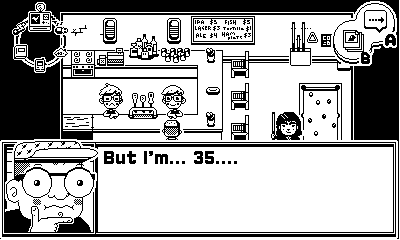
My previous post said that Whitewater Wipeout didn’t do much to plant a unique flag for the Playdate in the gaming landscape. This is the other game available in the first week of Season One and it helps the system’s case significantly. It makes me wonder if instead of the crank or the minimalism that comes about from the hardware’s (mostly intentional) limitations, the Playdate’s unique selling point may be irreverence. Just a moment before you leave. WW has its surfer dudeisms and makes light fun of the player’s failures with a you-suck tone you don’t often see in non-indie games. I can take or leave that. Casual Birder, however, wouldn’t be anything without its sense of humour. There’s cheeky NPCs, over-the-top character portraits, and nebulous, exuberant flavour text. This kind of self-awareness is always at risk of making a game feel dated or too-clever-by-half, but CB mostly sticks the landing by piling great little moment upon great little moment until it’s over and you have several screenshots of smiles it brought you to look back on.

To rattle off these instances would be to rob you of the fun of coming across them yourself, so I’ll just share one as an example. One bird can only be found if you repeatedly litter in a coffee shop, annoying the barista until they literally throw you out with the trash… which attracts a bird to snap. More generally, the game’s presentation is phenomenal. The Playdate must have an impressively high pixel density to be able to pull off the different shades of darkness in caves. It reminds me a little of World of Horror, or how PC-98 games would achieve amazing colours and detail through dithering. Squint in houses and marvel at the surprising detail, like posters with miniscule writing and tiny desk decorations. NPC character portraits are sometimes so expressive and detailed they bring to mind Phoenix Wright defendants melting down. Max Coburn’s music (a.k.a Maxo… brought back good memories of Cool Games Inc.) sounds almost like a parody of videogame music, but with such solid, jaunty funk that it remains catchy long after the gamey novelty disappears. The tone captures Casual Birder as a whole: a short, cheerful videogame thrilled to be a videogame. A great fit for a system that seems itself intended for short, cheerful experiences.

Whitewater Wipeout (Playdate S1 #1)

Release: February 19th, 2021

Developer: Chuhai Labs

An arcade-type game where you use the crank to try to keep your surfer on the waves as long as possible while doing tricks to score points. Really, that’s more or less it. Most of my interest in Whitewater Wipeout comes from the pause it gave me about what it means to be a system’s first game.

You get two games every week in Playdate’s ‘Season One’. This is likely the first one of the two you will play because it shows up first in the system menu. I mentioned in my last post that the Playdate feels like a Game Boy with its limited inputs and small monochrome display. For many, that system is synonymous with its pack-in game, Tetris. Easily understood and infinitely addictive, Tetris kicked the door open not only for people who didn’t have the time or living scenarios for console or arcade gaming, but people who didn’t even know videogames were something they’d like. There’s a generation of people for whom the medium begins and ends with Tetris. From cartridge one, the Game Boy’s place in history was assured.

Not every first pack-in game can change the world like Tetris, but I’d say it should function as something of a mission statement for its system; showcasing its strengths or what it brings to the medium. Sonic the Hedgehog deliberately and directly kicked sand in the face of a particular market competitor with graphics and speedy scrolling that their rivals Nintendidn’t have. Wii Sports was the ideal demonstration for how the Remote could intuitively remove the most obtuse roadblock for non-gamers, the controller. Whitewater Wipeout is here to tell me that… the Playdate has an analogue crank. Perhaps developer Chuhai Labs (incidentally, run by Giles Goddard of Star Fox development fame) didn’t know that their game would be the first thing most Playdate owners would play. Maybe they had no input in how the Season One schedule got rolled out. It’s a solidly built toy of a game that does one thing and just one thing very well, but it feels like a shortsighted first pick.

On first impression, I wrote a pretty dismissive and now-deleted tweet where I basically called it a tech demo, and I bounced off of it within 15 attempts to keep my dude on his board for more than a minute. While the crank felt great to spin, WW didn’t show me how it could be a gateway to exciting new or exclusive experiences, or like it was solving a problem I’d had with other systems. Had my Playdate not had firmware issues that required an assisted factory reset, I’d probably never have touched it again. I’m glad I did though, because somewhere around my thirtieth or so attempt, something clicked. Like the first time you don’t fall off your bicycle immediately, I was able to keep my surfer on water longer than a few seconds. I was in the pocket. The inertia was mine. I understood. The trick was to launch off waves and make sure that the board’s nose was pointing directly back down. It was a simpler, less potent version of that rush you get when the music starts playing for a few seconds consistently in QWOPI’m doing it! I’m doing it! I’m actually doing i– ah, well, I was, for a moment there. One more try… 


Soon enough, I was doing triple-360s like they were nothing, able to keep my surfer up as long as I was giving it my full attention. But to what end? Getting higher scores. The online leaderboard, predictably, has scores so astronomically high I wonder if the runs that they were earned on are counted in minutes or hours in duration. Tetris, too, is a high-score beater, but the mass appeal lies in the randomisation and the tangible sense of improvement, making bigger plans and gambles in anticipation of future blocks. That’s a very different form of reward from WW, where high-level performance feels like pulling off a string of sick fingerboard tricks. You’ll enjoy it as long as you find the momentum and rhythm of skillfully using the crank enjoyable. For me, that was about 90 minutes. For you, it could be less or a lifetime.