

Release: September 16th, 2021
Developers: May-Li Khoe, Andy Matuschak, Andrés Velasquez
A weird one on a system of ‘weird ones’. Boogie Loops is a music tracker (a type of synthesiser) in the vein of the music-making components of creative software games like Mario Paint or WarioWare DIY. Crank usage is the most daring I’ve seen yet: none at all. This is the first Playdate release in Season One that doesn’t feature a unique function that only the crank can provide. In fact, it’s probably the first game to seriously chafe at the system’s limitations. Then again, calling it a game at all may be a bit strong. Like Whitewater Wipeout and Casual Birder, it did get me thinking more about what the Playdate’s ethos and purpose in the modern handheld world is than the software itself.
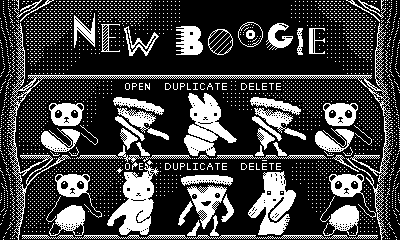
Boot it up. No title screen. Half the screen will be occupied by cute creatures dancing in time to a sequence of notation on the bottom half. A pre-made beat and melody far beyond anything I have the skill or patience to approximate can be played and altered right away. There isn’t any in-game documentation as to how to engage with it. While you’ll certainly wring more out of it if you have a rudimentary understanding of music theory or how to use a tracker, you’ll still have to find out through trial-and-error what odd sound sample each piece of iconography represents.
Part of the Playdate’s appeal, it seems, is that it wants to instill a little bit of mindfulness in your gaming diet. Games may not be cheap these days, but they are plentiful. At the time of writing, it is 2024. Despite being considered a ‘slow’ year, there is still more coming out than any one person could reasonably keep up with. I really feel for indie developers (and, increasingly, even major ones): you toil on a project for years and if you’re lucky you’ll get 15 minutes of fame and recoup costs before it gets lost in the sauce of constant, unrelenting big name releases and interesting smaller projects. Because the Playdate serves you two games weekly (with more available individually at a price), it encourages you to stick with them until next week. I wouldn’t give Whitewater Wipeout a second look if it was free on Steam, but the attention afforded it by being one of my two weekly games meant I stuck with it longer.
Like Whitewater Wipeout, I would say that having this be the fourth ‘game’ out of the gate in your system’s first season of 24 games is a little early, but I don’t want to levy that too hard against Boogie Loops itself. If it’s your first time seeing a music tracker, then its cute and lively presentation, with absolutely zero direction as to how to use it or what things do, encourages experimentation. Unfortunately, unless you have tremendous patience, then its limited utility and the frustration of having to haul the cursor across the screen with the D-pad (as opposed to a mouse pointer or touch screen) quickly makes the process feel like a chore.
If I presented this to someone who doesn’t normally play games I’m sure they’d probably get a curio’s fun out of it over a cup of coffee. I could imagine a younger me, without anything else to ‘play’ until the next birthday or Christmas rolled around, would have persevered a bit more, worked out how to make good things by tinkering around, and possibly even discovered I actually seriously enjoyed music at a much younger age than I actually did. As reality stands, the best Boogie Loops did was remind me of the (far more fully-featured) KORG applications on the 3DS, and to get around to properly configuring my DAW to better record my actual guitar and bass. Nevertheless, it fits an emerging subtext in the Playdate release schedule: don’t rush. Take your time. Remember to have fun.


 Shrunken Shrine